
.webp&w=48&q=75)
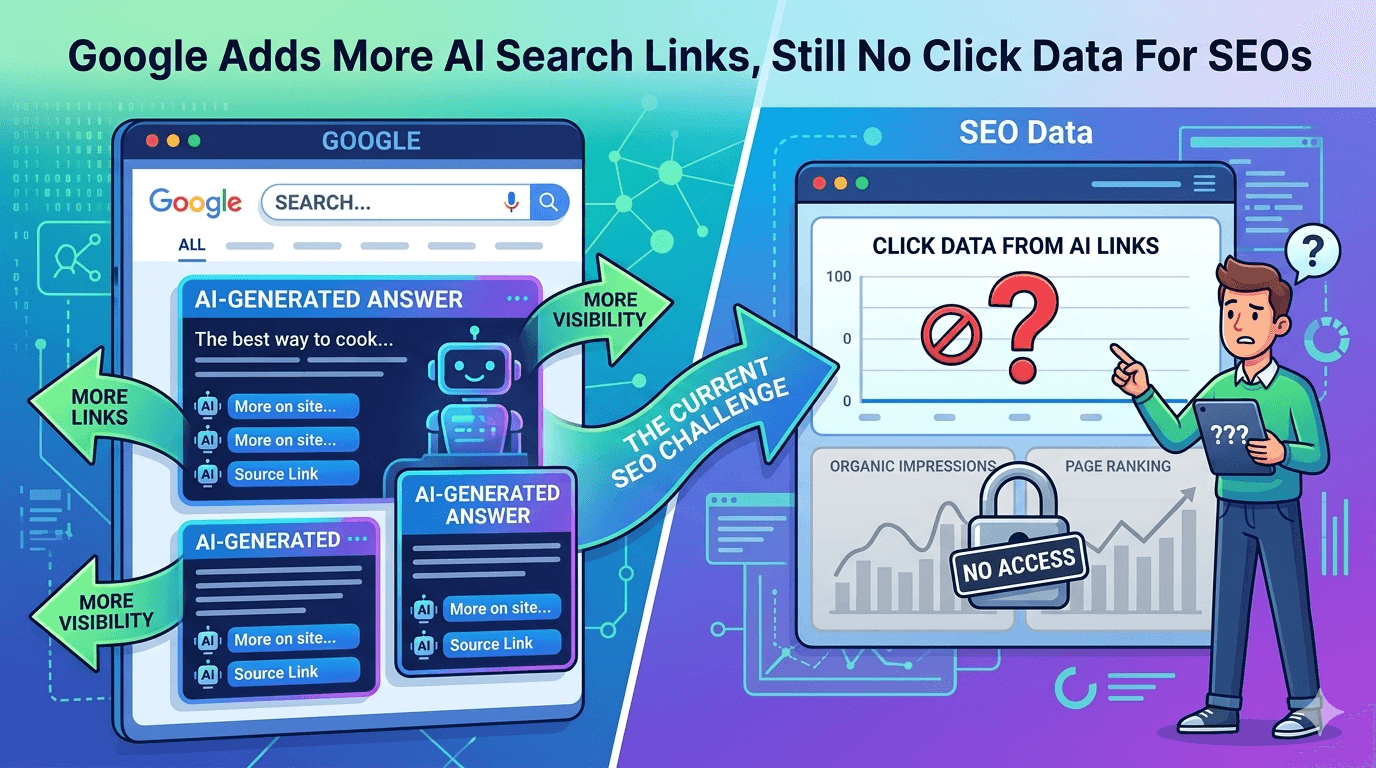
Google just expanded link visibility inside AI Overviews and AI Mode.
On the surface, this sounds like good news for publishers and SEO professionals.
But there’s a bigger issue underneath it.
Google is adding more ways for users to stay inside AI-powered search experiences while still not giving publishers meaningful reporting about what actually happens after those AI answers appear.
The company continues to push AI Mode deeper into Search with conversational follow-ups, summarized answers, embedded citations, social proof panels, and predictive query journeys.
This matters because the traditional search journey looked like this:
Query → SERP → Click → Website
Now it increasingly looks like this:
Query → AI Answer → Follow-up → More AI → Maybe a click
According to research from Pew Research Center, users clicked traditional search results in only 8% of visits when an AI summary appeared, compared to 15% when it did not. Users also clicked links inside AI summaries only about 1% of the time.
Another 2026 research paper studying Google AI Overviews found approximately a 15% decline in traffic to affected Wikipedia pages after AI summary exposure.
Several SEO platforms and industry analysts are reporting even more aggressive CTR reductions in AI-heavy result environments.
The latest updates include:
– Inline contextual links inside AI responses
– Hover previews on desktop
– Subscription-based news source visibility
– “Expert Advice” and community discussion snippets
– More follow-up exploration prompts
Google clearly understands the criticism around zero-click search.
The company knows publishers are worried.
The issue is that visibility is no longer equal to traffic.
Being mentioned inside AI answers and being visited are now two different outcomes.
That is a major shift in how SEO value should be measured.
Search Console Still Has A Visibility Gap
This is where most SEO teams are frustrated.
Google still does not provide detailed publisher-level reporting that separates:
– AI Overview clicks
– AI citation impressions
– AI Mode engagement paths
– Citation-assisted conversions
– Follow-up AI interaction journeys
So businesses are trying to optimize for a system they cannot fully measure.
That creates a dangerous scenario.
Many brands still rely entirely on traditional SEO KPIs:
– Rankings
– Organic sessions
– CTR
– Position averages
But AI search changes the economics of visibility itself.
A page might influence the answer without generating the click.
Traditional analytics were never designed for that reality.
SEO Is Quietly Turning Into “Citation Optimization”
This is probably the biggest strategic shift happening right now.
In AI search, visibility increasingly depends on whether your brand becomes a trusted source for synthesis engines.
Not just whether you rank #1.
Research is already showing weak overlap between traditional top-ranking pages and pages cited by AI systems.
That means businesses need to optimize for:
– Entity authority
– Consistent brand mentions
– Expert attribution
– Multi-platform presence
– Original insights
– Quotable statistics
– Structured content
– Semantic clarity
– First-hand experience signals
This is why forums, Reddit discussions, LinkedIn posts, YouTube transcripts, expert commentary, and PR mentions are becoming increasingly important in AI search ecosystems.
They will be the brands that become:
– Frequently cited
– Repeatedly referenced
– Contextually trusted
– Topically associated with expertise
That is a completely different game.
In many industries, traffic volume may decline while authority influence increases.
The companies adapting fastest are already shifting toward:
– AI visibility tracking
– Brand entity optimization
– Expert-led content
– Multi-platform content distribution
– Knowledge graph alignment
– Structured authority building
– AI citation monitoring
– Human experience-driven publishing
This is also why generic AI-written content is struggling harder now.
AI systems increasingly reward information gain, experience depth, and recognizable authority signals.
Google adding more links inside AI Search is not a solution to the publisher problem.
It is Google trying to balance two competing priorities:
If your business is struggling to adapt to AI Overviews, AI Mode, declining CTRs, or changing organic visibility patterns, I help brands build AI-first SEO and authority strategies designed for both traditional Google rankings and modern AI retrieval systems.
From AI visibility audits to entity optimization, content systems, semantic authority building, and LLM-focused search strategy, the goal is simple:
Stay visible where search is actually moving.
You can learn more or book a consulting session through SanjayB.com

.webp&w=32&q=75) 27 May 2026
27 May 2026