
.webp&w=48&q=75)
I want to talk about Google Ads CTV strategy that I keep seeing get misread in marketing conversations right now.
Everyone is talking about CTV like it is a new channel to add to the media plan. Another line item. Another budget conversation. That framing is wrong and it is costing brands real money.
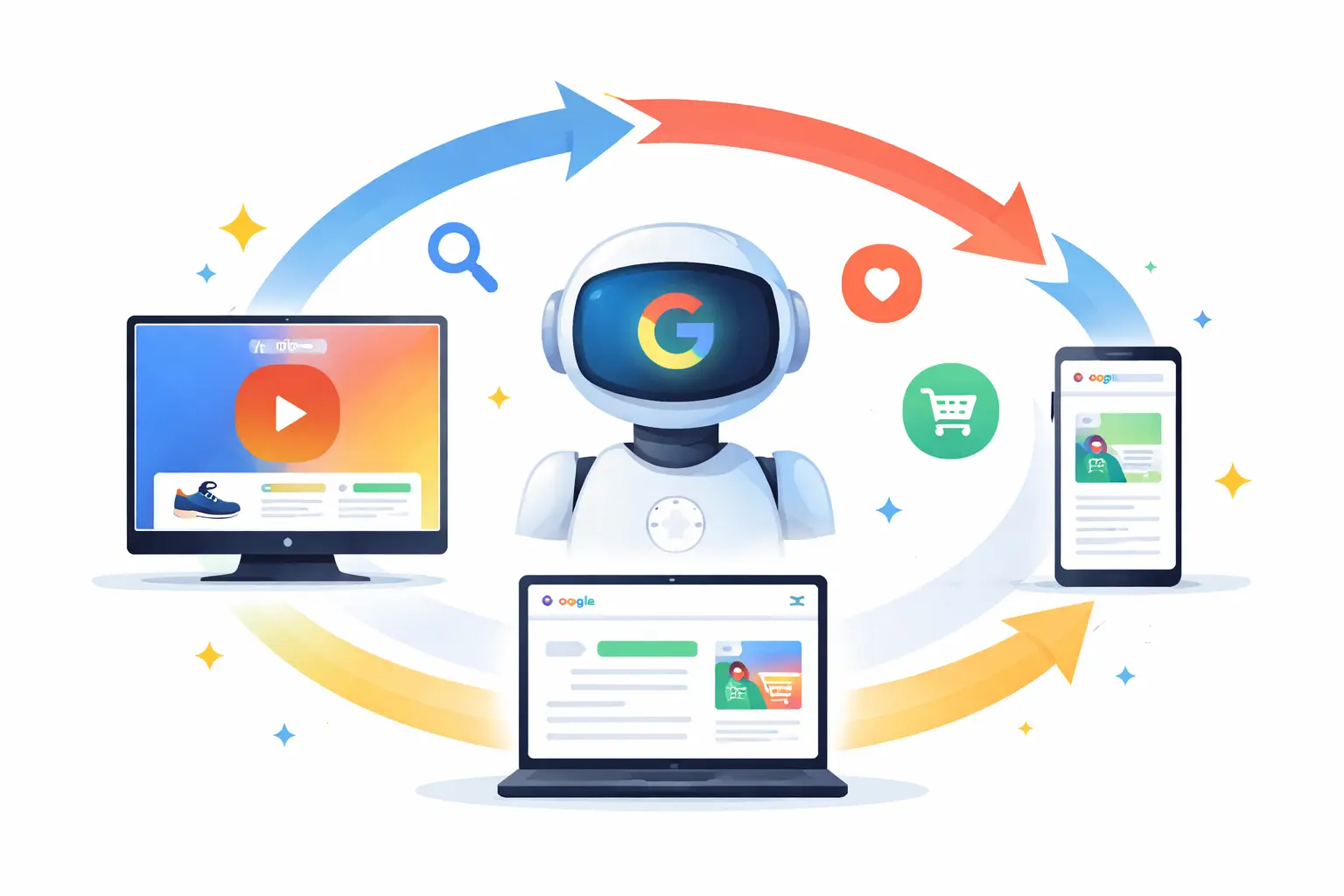
Google Ads now distributes ads across Search, YouTube, and Connected TV through Performance Max, using AI to optimize delivery and attribution across devices. This turns advertising from channel-based planning into a unified, cross-screen system.
The line between search, video, and TV has been disappearing for two years. It is now essentially gone.
A few things happened in quick succession that together tell a bigger story.
Google launched non-skippable Video Reach Campaigns globally, built specifically for connected TV screens. Non-skippable. Full message. Living room. Google AI dynamically optimizes across 6-second bumper ads, 15-second standard spots, and 30-second CTV-only formats without you manually splitting budget by format.
In January 2026, Google launched shoppable CTV ads through Performance Max. Viewers watching YouTube on a connected TV can now see product information overlaid on ads with QR codes they can scan to browse and purchase directly. The ads pull from Google Merchant Center. If you are running PMax with an active Merchant Center feed, your campaigns may already be eligible.
Eighty percent of Performance Max advertisers are now receiving CTV impressions through YouTube. Most of them have not checked the Channel Performance report in their Google Ads account and have no idea this is happening.
And then on March 20, 2026, Google begins automatically adding AI-generated voiceovers to Performance Max video ads that do not already have a voice track. Not opt-in. Opt-out. The window to disable it closed on March 20. If you missed it, Google's AI is now narrating your video ads using your own headlines and descriptions.
These are not beta experiments. These are live rollouts. The platform is already doing this at scale.
According to a Nielsen report, YouTube has been the #1 streaming platform in the US by watch time for multiple consecutive periods. It has over 7 million YouTube TV subscribers.
By 2026, an estimated 80.7 million US households have cut the cord, and a large percentage of their streaming time is happening on YouTube through smart TVs.
What Google has done is take that inventory and plug it directly into Performance Max, which already controls your Search, Shopping, Display, and YouTube campaigns in a single AI-managed system.
CTV is now another input into that system. The algorithm decides when to show someone a TV ad to prime them, then captures them later through a Search or Shopping ad. It tracks that journey. It attributes that conversion.
Branding and performance marketing converging on the same screen, managed by the same AI, is not a future scenario. It is the current default for any Performance Max advertiser.
And the data supports this. Google reported in January 2026 that Demand Gen campaigns including TV screens drive an average 7% additional conversions compared to campaigns that do not include TV screens, at the same ROI.
Seven percent incremental conversions just from adding the TV channel.
Go into Google Ads, select your Performance Max campaign, and pull the Channel Performance report under Insights and Reports. It shows a breakdown of spend and impressions across Search, Shopping, Display, YouTube, and CTV.
If you have not looked at this, you may already be spending budget on TV placements with creative that was never designed for a TV screen.
An AI-converted product photo on a 65-inch screen is not the same thing as a purpose-built CTV creative. Brands that invest in video built for the full screen consistently outperform brands running machine-converted static images in CTV placements.
The shift to CTV does not mean repurposing your Instagram Reels. CTV is a lean-back, full-screen, non-skippable environment. The viewer is not holding a phone. They are sitting on a couch. Creative that works for mobile scroll does not work for the living room.
If cross-channel campaigns are going to be the default and AI is going to be distributing your creative across screens without you manually deciding where it goes, the creative has to work in every context it might land in. Build for the biggest screen first. Everything else scales down.
Last-click attribution is already outdated. In a system where Google's AI shows someone a CTV ad on their TV, retargets them on YouTube on their phone, and then captures the conversion via a Shopping ad, last-click tells you nothing useful about what drove the result.
Data-driven attribution, view-through conversion tracking, and incrementality measurement are not optional additions to your reporting setup anymore. They are the minimum baseline for understanding what your campaigns are actually doing across a multi-device journey.
If your marketing team is still measuring CTV the way it measured TV three years ago, meaning reach and frequency with post-campaign brand lift studies, that methodology does not fit the system you are buying into now.
Google is not expanding your advertising options. It is expanding its control over how your advertising runs.
Every move in the past 18 months points in the same direction. Performance Max absorbs more channels. AI generates more creative variations without asking you. Voiceovers get added to your videos automatically.
CTV placements start running from your Shopping feed without a dedicated budget. The advertiser's job is shifting from managing campaigns to managing guardrails.
For brands that lean into this and get their creative strategy, measurement framework, and audience signals right, the efficiency gains are real. The 7% incremental conversion lift from adding TV screens is one data point.
Seer Interactive found that brands cited in AI Overviews see 35% more organic clicks and 91% more paid clicks versus brands not cited on the same queries. The same compounding dynamic is playing out in CTV.
For brands that treat this like a channel update and keep running the same static creative strategy, the gap between them and competitors who have adapted will get wider every quarter.
Stop thinking about YouTube as a video channel and CTV as a TV channel. They are now one delivery system that Google's AI runs across every screen in your customer's life. Your job is to give that system the best possible inputs: creative that works at every size, audience signals that are first-party and clean, and measurement that captures the full journey rather than just the last click.
The brands building video-first creative strategies today are the ones who will have structural advantage when cross-channel AI campaigns are the complete default and not the experiment.
That point is closer than you think.

With over 16 years at the forefront of strategic business growth, Sanjay Bhattacharya collaborates with CEOs and founders to reshape market positioning and drive sustainable success. Throughout his journey, he has worn many hats—from Fractional CMO for fast-growing startups to serving as Head of Marketing & Business Strategy at PRIMOTECH. He has been Featured in Under30CEO, American Marketing Association, CMO Times, CTOsync, DesignRush, Earned, HubSpot, MarketerInterview, and more.
.webp&w=32&q=75) 06 Oct 2026
06 Oct 2026