

.webp&w=48&q=75)
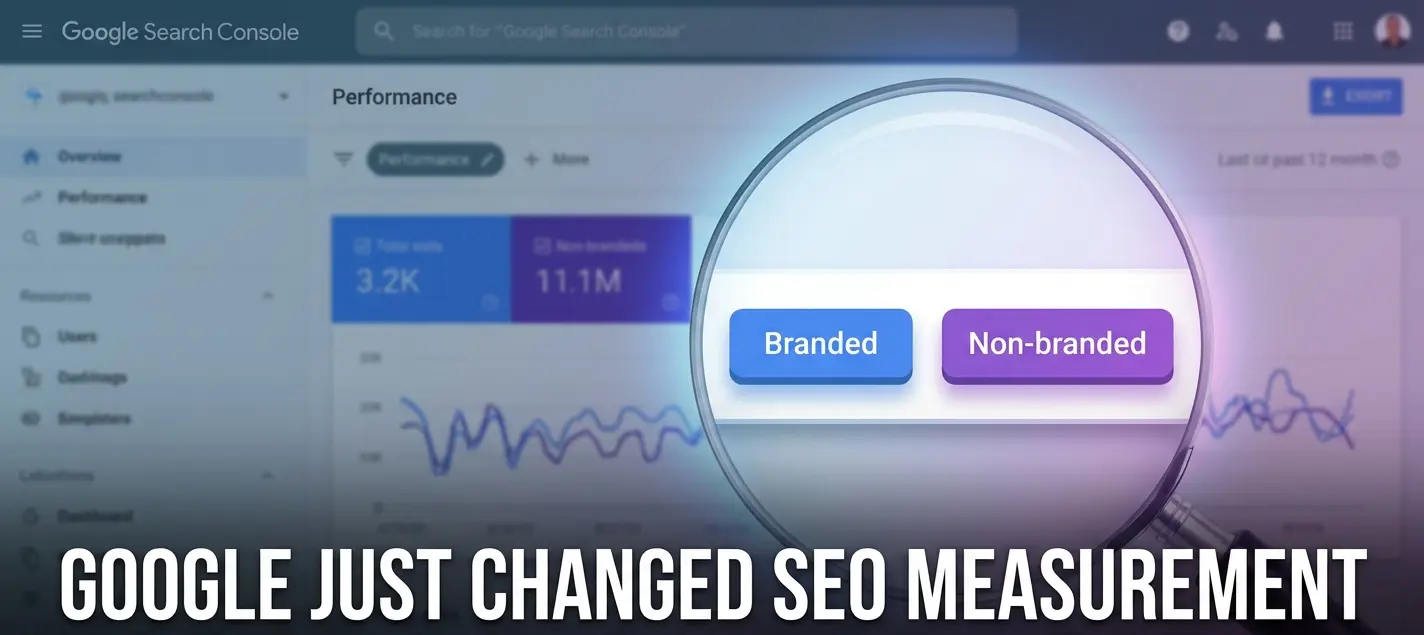
Google recently shared clarity on branded vs non-branded traffic, and how it is now separated queries natively.
So, no regex workarounds, keyword lists stitched together in spreadsheets, and no approximations that were always slightly wrong.
Yes, it is not just an UI update.

Inside the Performance report, you now get a built-in filter: branded queries and non-branded queries. Google uses its own classification systems to sort brand names, misspellings, product names, and indirect brand references.
We were doing this before with regex. But regex was educated guesswork. This is closer to the actual signal.
Most SEO reports lump everything together.
And they tell a story that isn't quite true. Here's the split that changes how you read the numbers:
If you're reporting on both as one number, you're measuring noise.
You're not growing. You're harvesting. Brand recall is strong, but your discovery engine isn't working. Your SEO isn't scaling, and your existing brand equity is doing the lifting.
You're discoverable but forgettable. Traffic arrives. It doesn't convert into memory or repeat intent. This is where content-heavy strategies quietly fail. You have lots of visitors, but low brand formation.
Now you're building something that compounds. Non-branded feeds discovery. Branded reflects recall. That loop is what durable organic growth actually looks like.
This update sits inside a bigger shift. Search is moving from keywords to entities to brands. Google is telling you, clearly, that it understands brand signals. You probably should too.
In LLM-driven search, users don't browse ten results. They ask. They get one answer. Non-branded queries get you visibility. Branded queries get you chosen. This filter gives you the first clean way to measure that split inside your own data.
One caveat worth noting
The classification isn't perfect. Some queries will be misclassified. Use this directionally, not as gospel. The value is in the trend, not the exact number.
If I'm running SEO for a client right now:
→ Track branded vs non-branded weekly, not monthly
→ Set separate growth targets for each, they require different strategies
→ Audit content against non-branded performance to find what's actually driving discovery
→ Use branded query growth as a proxy for brand lift over time
→ Stop reporting total clicks as the headline metric. That number flatters. It doesn't inform.
SEO got more honest. You can now see what your brand is doing separately from what your content is doing.
Once you see that clearly, the old way of reading reports stops making sense.
Take note that branded and non-branded traffic require different strategies, different targets, and different content investments. Measuring them together was always a shortcut. Now you don't need it.

With over 16 years at the forefront of strategic business growth, Sanjay Bhattacharya collaborates with CEOs and founders to reshape market positioning and drive sustainable success. Throughout his journey, he has worn many hats—from Fractional CMO for fast-growing startups to serving as Head of Marketing & Business Strategy at PRIMOTECH. He has been Featured in Under30CEO, American Marketing Association, CMO Times, CTOsync, DesignRush, Earned, HubSpot, MarketerInterview, and more.

.webp&w=32&q=75) 06 Oct 2026
06 Oct 2026