
.webp&w=48&q=75)
I've seen the search evolve dramatically in the past 15 years, from keyword matching, EEAT, quality score updates, to BERT, core web vitals, and the last March update.
Each change fundamentally pushed us as marketers to dive deep and work around a strategy adjustment to stay in the game. However, I feel the underlying game stayed the same: you need to earn visibility on a results page if you want to grow your business.
Yes, it is as simple as that, but it is becoming one of the hardest things to achieve for a marketer.
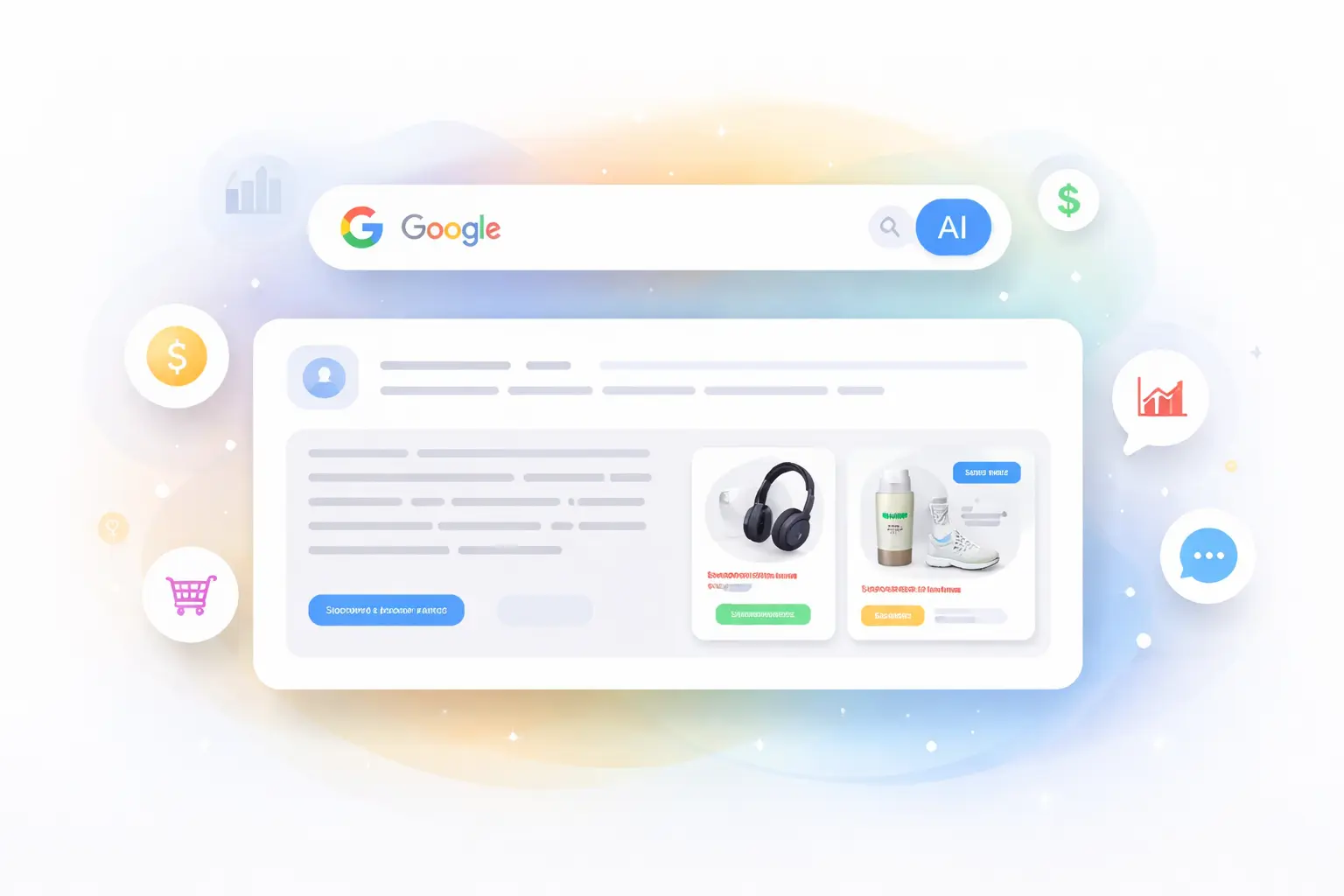
AI Overview Ads: Google is now expanding sponsored placements and product recommendations embedded directly inside AI-generated answers.
Not beside them. Not below them in a traditional ad block. Inside the answer itself.
The line between "what the AI says" and "what someone paid to appear" is now, officially, a thing that can be negotiated.
This didn't come from nowhere. At Google Marketing Live 2025, Google confirmed it was expanding ads in AI Overviews and testing placements in AI Mode, describing the move as a way to bring advertiser expertise directly to consumers making purchase decisions.
AI Overviews reached 2 billion monthly users back in July 2025.
AI Mode surpassed 100 million monthly active users in the U.S. and India alone.
Now I can confidently say that these have become the primary interface for a growing share of search sessions.
In December 2025, Google quietly expanded AI Overview ad placements to 11 new English-language markets, including Australia, Canada, India, and Singapore, with ads surfacing based on both query intent and AI-generated summary context rather than keywords alone.
Most advertisers missed that update entirely because it shipped through support documentation, not a press release.
A January 2026 analysis of Google AI Mode network traffic found that ad auctions were already running in the background within 60 milliseconds of every AI Mode search, complete with attribution tracking infrastructure, even though ads weren't yet visible to users.
Read that again. The infrastructure was already built and running. The monetization switch was already wired.
Google has also launched a pilot called Direct Offers, allowing advertisers to display exclusive promotions directly within AI Mode for users showing clear purchase intent, with plans to enable checkout directly inside AI Mode from select merchants.
The path from question to purchase is collapsing into a single session.
Organic results, paid placements, and the AI answer are merging into one surface.
That's not a feature update.
That's a fundamental restructuring of how search works commercially.
"Previously challenging to monetize" means high-consideration, research-heavy queries. The ones where users were building understanding, comparing options, and narrowing decisions.
Google couldn't reliably monetize those before because the journey was too long and the intent too diffuse.
AI Mode collapses that journey.
If a user gets a synthesized answer, sees recommended brands, and then gets a sponsored next step that feels contextually aligned with the answer, organic results aren't just lower on the page. They may not be in the decision at all.
That's the thing I'd want every SEO and paid search team to be arguing about right now. Not "how do we appear in AI Overviews" but "what does our visibility strategy look like when the answer layer is also the ad layer."
Google provides no ad-level reporting for AI Overview placements. No placement data, no impressions, no clicks broken out by surface. Advertisers are paying into a system they can't measure at the placement level, on a surface that's becoming the primary interface for a growing share of queries.
That's not a minor transparency gap.
That's a structural problem for any team trying to optimize budget allocation between traditional search and AI-mediated search.
Between January and June 2025, over 80% of AI Overview ads appeared below the AI box, while a consistent 18 to 20% appeared above it, but that data came from third-party SERP tracking, not Google. Official reporting still doesn't isolate it.

The brands getting ahead of this are the ones building dual visibility frameworks now, before the auction gets crowded and before Google's measurement catches up to its own monetization.
Ads in AI Overviews are not new ad formats. They're new placements for existing Search, Shopping, Performance Max, and other AI-powered campaigns, labeled as Sponsored and integrated into the AI-generated experience.
Your existing campaigns are already eligible. The question is whether your content and product feeds are structured in a way that makes them competitive at the answer layer.
Traditional SEO levers, including backlinks and keyword optimization, now carry less weight as AI systems emphasize originality, expertise, and behavioral satisfaction signals.
Generative Engine Optimization isn't a future consideration anymore. It's the current game.
If your content isn't structured to be cited inside an AI-generated response, you're building visibility for a version of search that's already shifting underneath you.
The integrated SEO and paid strategy we've been talking about for years isn't a nice-to-have framework.
Right now, it's the only coherent way to think about search visibility, because paid and organic are converging into a single answer-layer competition. The teams still running those as separate workstreams are going to feel that gap in the next two quarters.
First, audit whether your top-performing organic content is structured for AI citation, not just keyword ranking. The signals that get you cited in an AI Overview aren't the same signals that put you on page one in 2022.
Second, check your product feeds. Google's AI determines when Direct Offers are appropriate to display based on query context, which means feed quality and offer specificity now directly affect AI placement eligibility.
Third, start tracking AI Overview presence by query, not just traditional ranking position. Third-party tools can do this even where Google's own reporting can't.
The brands that move on this in Q2 are going to have a structural advantage by Q4. The ones that wait for the playbook to be obvious are going to be writing catch-up briefs when everyone else is already optimizing.
Search hasn't looked like this before. Which means the strategies that worked before won't be sufficient. That part, at least, is no longer a prediction.

With over 16 years at the forefront of strategic business growth, Sanjay Bhattacharya collaborates with CEOs and founders to reshape market positioning and drive sustainable success. Throughout his journey, he has worn many hats—from Fractional CMO for fast-growing startups to serving as Head of Marketing & Business Strategy at PRIMOTECH. He has been Featured in Under30CEO, American Marketing Association, CMO Times, CTOsync, DesignRush, Earned, HubSpot, MarketerInterview, and more.
.webp&w=32&q=75) 06 Oct 2026
06 Oct 2026