
.webp&w=48&q=75)
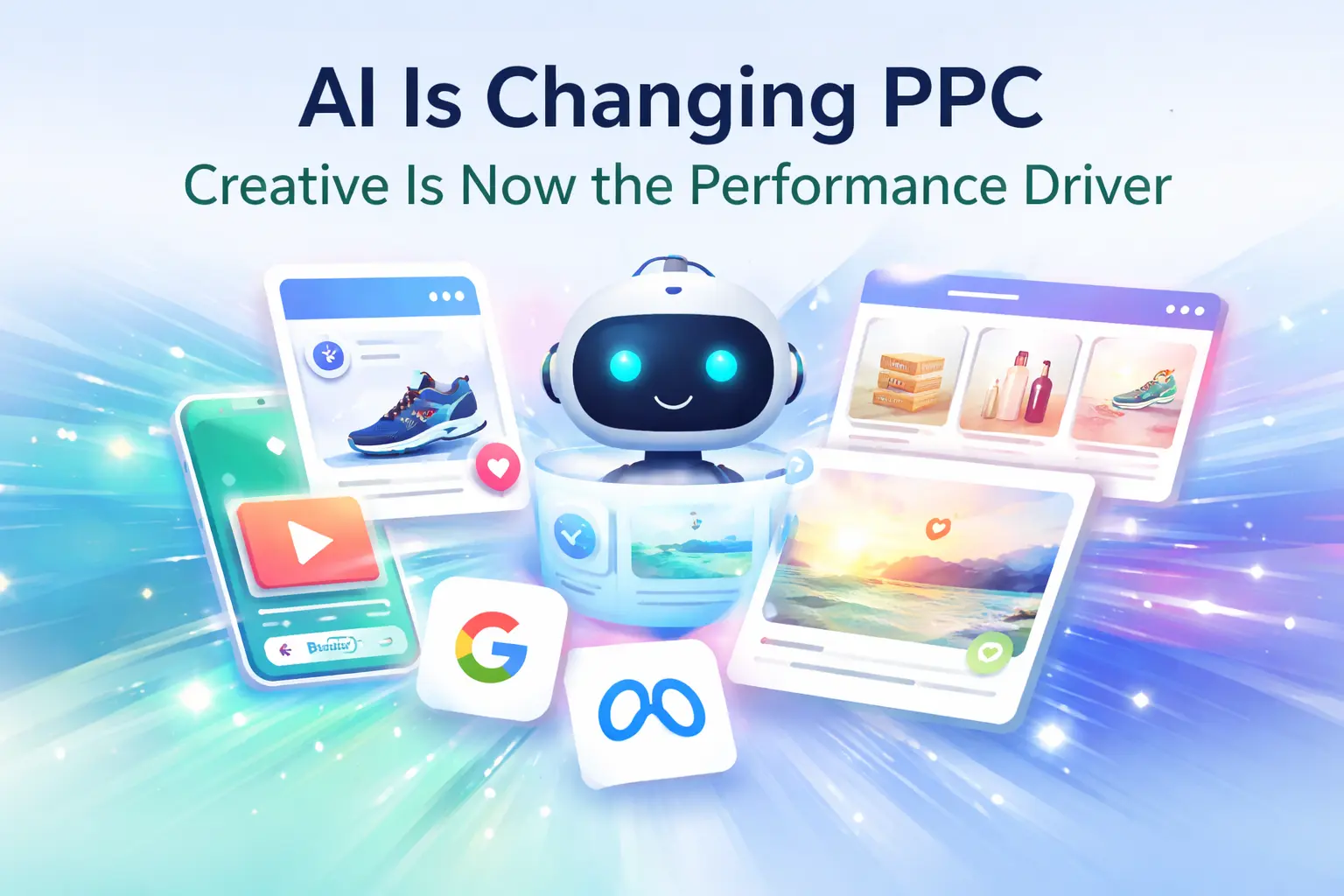
As someone who has spent 15+ years working across paid media strategies, I can tell you that the biggest shift happening in PPC right now is the ai creative layer.
Major ad platforms like Google, Meta, and others have embedded AI tools directly into ad creation workflows.
We're talking about tools that generate images, backgrounds, and synthetic lifestyle scenes without leaving the platform interface.
Google's generative tools like Veo 3 and Asset Studio can produce studio-quality creative assets in minutes.
Meta's system, powered by its GEM generative AI model, evaluates creative elements like visuals, hooks, and language, to determine relevance and optimise delivery.
This is a meaningful structural change in how PPC campaigns work.
For years, the primary lever in paid search was the keyword. You built tightly controlled lists, matched intent, and competed on bid strategy.
That era is ending.
PPC campaigns are becoming asset-driven ecosystems. Creative is now the primary performance signal, particularly on Meta, where Andromeda (Meta's AI retrieval system) evaluates ad creative first to determine which users are likely to engage, before audience targeting even enters the picture.
Broad targeting is now outperforming granular interest stacks because the creative itself carries the targeting signal.
On Google, the same logic applies. Product leaders have been explicit: creative is now the primary lever for campaign performance.
Advertisers who invest in diverse, high-quality assets like image, video, and text are measurably outperforming those with generic creative, regardless of how sophisticated their campaign structure is.
The ability to generate dozens of creative variations in minutes solves a real production problem. Testing used to be gated by how fast a design team could produce assets. That constraint is largely gone.
But here's the thing: the advantage was never who could produce ads fastest. AI has equalised that. Everyone has access to the same generation tools.
The advantage is now something much harder to automate. Understanding your audience's psychology and maintaining authentic brand identity across generated assets.
Companies that separate themselves will be the ones that combine AI's efficiency with a clear identity and genuinely differentiated creative.
The risk isn't that AI generates too little. It's that as more advertisers use the same systems, creative starts to look identical, and quality gets buried under volume.
This isn't a technology problem. It's a strategy problem.
→ Test AI creative variations systematically: don't just generate and launch; build a structured testing framework that tells you what's working and why
→ Set brand guardrails before you generate: Google's Asset Studio now supports brand guidelines (approved phrases, tone, restrictions); use them, or your AI-generated assets will drift
→ Feed the algorithm variety, not just volume: Meta's system rewards diverse creative inputs: different angles, formats (images, video, UGC, carousels), and audience-specific messaging hooks
→ Combine human strategy with AI asset generation: human decision-making on creative direction still outperforms AI on nuance, brand context, and judgment calls; use AI for production, not strategy
→ Refresh creative regularly: Google recommends refreshing static creative every 4–6 weeks, video every 8–12 weeks; creative fatigue is accelerating as volume increases
More creative generation capability is genuinely useful. But the marketers who treat it as a shortcut by generating at scale without a clear creative strategy are going to end up with a lot of mediocre ads running at speed.
The creative generation problem is solved. The audience understanding problem is not.
That's where the real work is, and it's what separates campaigns that perform from campaigns that just run.
AI has made creative production faster and cheaper for everyone. That means the edge now belongs to marketers who understand their audience deeply enough to brief AI well, test with discipline, and maintain brand authenticity across hundreds of generated variations.
Advertising platforms now rely on machine learning models that evaluate creative elements such as images, video, and messaging to determine ad relevance and engagement potential.
AI tools now generate and test creative variations at scale, allowing algorithms to learn which assets perform best across audiences.
An asset-driven campaign is one where performance is primarily influenced by the creative assets used in ads rather than by keywords, bids, or manual audience targeting.
AI systems evaluate creative relevance and engagement signals to match ads with users, making broad targeting more effective when supported by strong creative assets.
Industry recommendations suggest refreshing:
static creative every 4–6 weeks
video creative every 8–12 weeks
to prevent creative fatigue.

With over 16 years at the forefront of strategic business growth, Sanjay Bhattacharya collaborates with CEOs and founders to reshape market positioning and drive sustainable success. Throughout his journey, he has worn many hats—from Fractional CMO for fast-growing startups to serving as Head of Marketing & Business Strategy at PRIMOTECH. He has been Featured in Under30CEO, American Marketing Association, CMO Times, CTOsync, DesignRush, Earned, HubSpot, MarketerInterview, and more.
.webp&w=32&q=75) 06 Oct 2026
06 Oct 2026