

.webp&w=48&q=75)
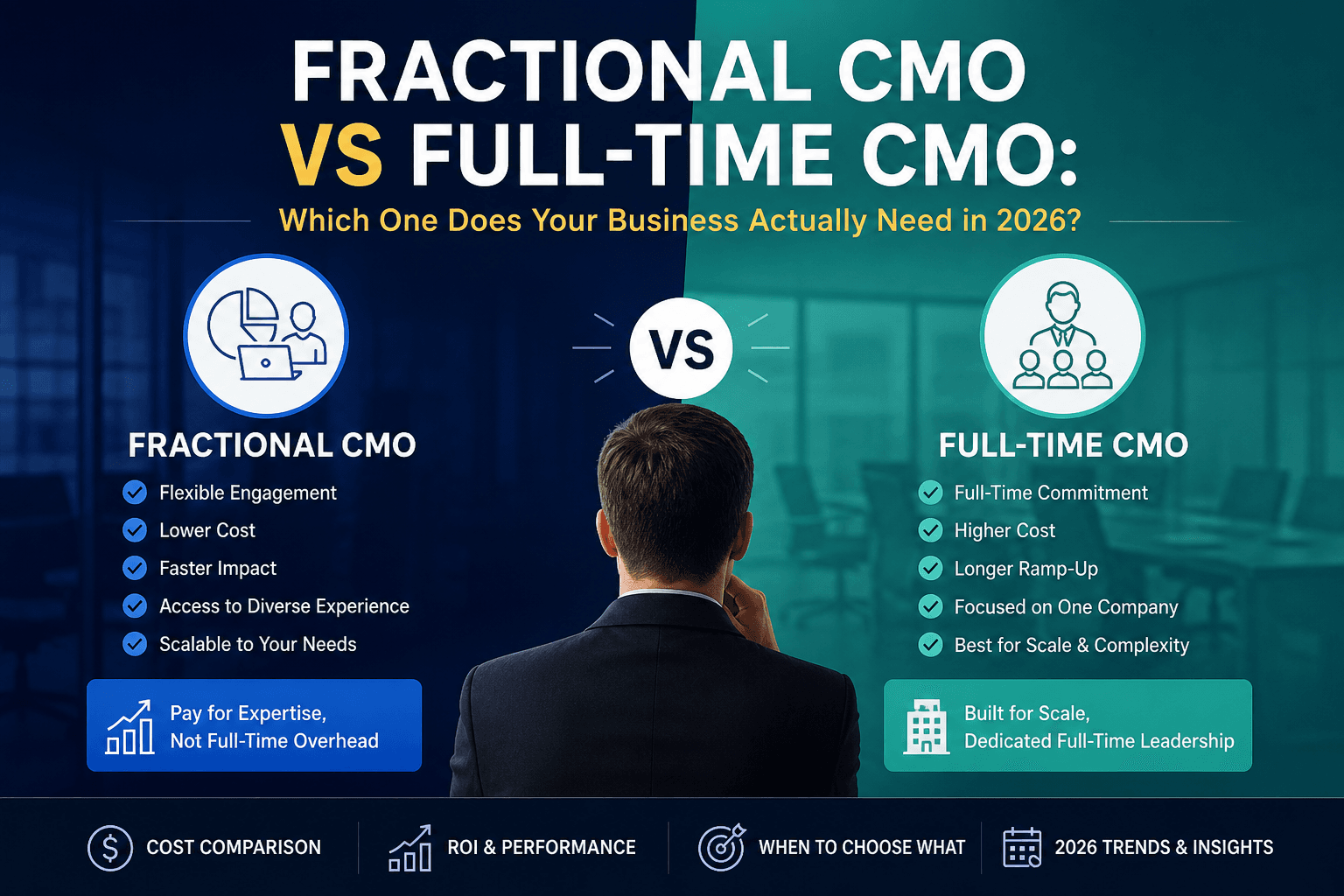
I get asked this question more than almost any other. A founder or CEO reaches out, revenue is growing, the marketing feels scattered, and they know something has to change at the leadership level. The question is always some version of the same thing: do we hire a full-time CMO, or is a fractional arrangement the smarter move right now?
My answer is always the same: stop framing it as a preference question. It's a business stage question. And once you understand your stage clearly, the answer practically makes itself.
Let me walk you through exactly how to read that answer for your specific situation, what each model genuinely costs in 2026, where each one fits, and the hiring mistakes I've watched companies make repeatedly in both directions.
Before comparing the two models, it helps to understand why this conversation is happening more frequently in 2026 than it was three years ago.
A McKinsey research found that businesses with unified, customer-centric marketing leadership at the C-suite level grow up to 2.3 times faster than those where marketing direction is split, siloed, or leaderless.
At the same time, Spencer Stuart's 2025 CMO Tenure Study shows the average CMO at an S&P 500 company now lasts just 4.1 years, the shortest run of any executive in the C-suite. These are the best-funded, most structurally stable companies in the world. If they can't hold senior marketing leadership, the challenge for growth-stage businesses is considerably steeper.
For growth-stage businesses, tenure is shorter, and failure rates are significantly higher. That decline doesn't mean marketing leadership matters less. It means the traditional model of accessing it is breaking down. At the same time, the global fractional executive market, valued at $5.7 billion in 2024, is projected to reach $19.1 billion by 2033 at a CAGR of 14.2%.
An independent LinkedIn curated research report shows job postings mentioning "fractional" titles have grown by 400% since 2022. The talent market has responded to what businesses actually need.
Most founders underestimate this number significantly. Here's what it actually looks like.
Hiring a traditional full-time CMO in 2026 means committing to a base salary ranging from $245,000 to $550,000 per year, plus benefits that typically add 20 to 30% of that figure, plus equity, recruiting fees, and onboarding costs. The true first-year cost easily exceeds $350,000.
When you add employer-side costs, the real picture looks like this:
|
Company Stage |
Base Salary |
Total Annual Cost (All-In) |
|
Startup / Sub-$10M revenue |
$180,000 to $250,000 |
$230,000 to $330,000 |
|
Growth-stage $10M to $50M |
$250,000 to $400,000 |
$320,000 to $500,000 |
|
Mid-market $50M+ |
$350,000 to $600,000 |
$450,000 to $750,000+ |
Sources: Glassdoor 2026, Salary.com 2026, Spencer Stuart CMO Tenure Study 2025
Then there's the ramp-up reality. A full-time CMO typically takes six to nine months before producing measurable results. Most companies never budget for that runway. And startup CMO tenure averages 18 to 24 months, with a first-time CMO success rate of 34% completing their initial contract, meaning most companies hire two to three CMOs over a seven-year growth period, multiplying both direct costs and disruption.
Fractional CMO retainers in the U.S. typically run $8,000 to $22,000 per month, saving most companies 40 to 70% versus a full-time hire at the same experience level.
|
Engagement Level |
Monthly Retainer |
Hours/Month |
Best For |
|
Advisory |
$5,000 to $8,000 |
8 to 12 hrs |
Strategic oversight, team guidance |
|
Standard Fractional |
$8,000 to $15,000 |
16 to 32 hrs |
$2M to $15M revenue companies |
|
Embedded Fractional |
$15,000 to $25,000 |
32 to 60 hrs |
Pre-exit, launches, major pivots |
|
Full-Time CMO |
$275,000 to $500,000/yr |
Full time |
$25M+ revenue, scaled marketing org |
Sources: Fractionus 2026, MarketerHire 2026, MarkCMO Pricing Guide 2026
The break-even point where a full-time CMO makes more economic sense is typically around $25 to $30 million in annual revenue, when you need true full-time dedicated leadership and can justify the total compensation package.
Below that threshold, the math is straightforward. At a $12,000 monthly retainer, you're spending roughly $144,000 annually for C-suite marketing leadership. That's 40 to 70% less than a full-time hire at the same experience level, with no benefits, no recruiting fees, no severance exposure, and no six-month ramp-up before you see results.
Cost comparison alone misses the more important question: what actually drives better outcomes?
Industry research from Geisheker Group finds that companies using fractional CMO leadership achieved 29% average revenue growth versus 19% for those without, a 10-percentage-point advantage.
Fractional CMO engagements produce 89% improved speed and flexibility, 74% lower risk, and a 91% satisfaction rate, compared to a 42% failure rate for traditional full-time CMO hires within 18 months.
Fractional CMOs who pair cross-industry strategic experience with AI-powered analytics platforms are delivering results 40 to 60% faster than traditional marketing engagements.
That speed advantage matters because it comes from a structural difference, not effort. A fractional CMO working across 15 to 20 companies has seen more marketing situations, more GTM failures, and more channel experiments than most full-time executives accumulate in a decade. They bring pattern recognition, not just seniority.
McKinsey's State of Marketing 2026 report found that only 6% of marketing organizations describe their use of generative AI as mature, and that group is already seeing 22% efficiency gains that they reinvest in growth. The fractional CMOs operating in 2026 who are worth hiring carry that AI fluency as a baseline. It's part of how they move faster.
|
Factor |
Fractional CMO |
Full-Time CMO |
|
Annual Investment |
$60K to $240K |
$275K to $500K+ |
|
Time to First Impact |
3 to 4 months |
6 to 9 months |
|
Cross-Industry Playbooks |
High, works across multiple companies simultaneously |
Limited to personal career history |
|
Flexibility |
Scope adjusts with business needs |
Fixed commitment, severance on exit |
|
Failure Risk |
Low, contract-based with defined deliverables |
High, 42% fail within 18 months |
|
AI Marketing Fluency |
Typically current |
Variable, depends on the individual |
|
Optimal Revenue Stage |
$1M to $25M |
$25M+ with scaled marketing org |
|
Board / Investor Visibility |
Situation-dependent |
Standard expectation |
Companies that once defaulted to hiring locally for senior marketing leadership are now actively asking whether geography still justifies the premium. In most cases, it doesn't.
An offshore fractional CMO, particularly one operating out of India like me with global client experience, gives US and UK businesses something the domestic market rarely delivers at this price point: genuine C-suite marketing depth, cross-market pattern recognition, and a cost structure that frees up budget for the execution layer that actually moves the pipeline.
US-based fractional CMOs typically charge between $500 and $750 per hour, while India-based fractional CMOs charge between $150 and $500 per hour, offering a cost-effective option for global firms. On a monthly retainer basis, that gap compounds substantially. A senior offshore fractional CMO engagement running $3,500 to $12,000 per month delivers comparable strategic depth to a US-based engagement at $15,000 to $25,000.
For a US startup between $3 million and $15 million in revenue, that delta isn't just a cost saving. It's the difference between affording strong marketing leadership at all and deferring it until a future funding round.
The objection I hear most often is about time zone and communication. It's a fair concern if we're talking about 2015. It's not a serious operational barrier in 2026.
Senior Indian marketing leaders like Sanjay Bhattacharya are working with US and UK clients who operate in overlap windows, run async communication natively, and have worked inside global brand ecosystems for their entire careers. The strategic vocabulary, the channel mix, and the buyer behavior nuances across North American and European markets are daily work.
What you actually get with an experienced offshore fractional CMO is someone who has navigated marketing across emerging and developed markets simultaneously, which builds a kind of strategic range that single-market practitioners rarely develop.
Understanding how to build brand authority in a competitive, price-sensitive market like India makes you significantly better at finding efficient growth levers in markets like the US and UK, where budgets are larger but competition is equally fierce.
India's senior marketing talent pool has adopted AI-powered marketing tools faster than most Western markets, partly because efficiency was never optional. Working with leaner teams and tighter budgets forces a level of tool fluency and process discipline that translates directly into faster execution for global clients.
Fractional CMOs who pair cross-industry strategic experience with AI-powered analytics platforms are delivering results 40 to 60% faster than traditional marketing engagements. An offshore fractional CMO who has built that capability out of necessity brings it as a default, not as an add-on.
Not every offshore fractional CMO is the right fit. The ones who are will have direct, verifiable experience running marketing for Western-market businesses, not just advisory roles. They'll understand your ICP, your competitive set, and your channel economics as well as any domestic hire would. They'll have clear communication systems, defined reporting cadences, and timezone overlap built into the engagement structure from day one.
What you're evaluating isn't geography. You're evaluating whether this person has built the kind of cross-market depth that makes them genuinely valuable to a business operating in your market.
For US, UK, and Australian companies willing to look past the default of hiring locally, the offshore fractional model isn't a compromise. It's often the most strategically sound marketing leadership decision available at the growth stage, where it matters most.
Revenue is between $1 million and $20 million, and marketing feels reactive rather than strategic. The founding team is making marketing calls, they know they shouldn't be making them at this stage. You've worked with agencies, and they keep asking you what you want instead of telling you what works. You need go-to-market clarity before your next fundraise. You have execution capability inside the team, but no one is setting a strategic direction.
If you're pre-product-market fit, you don't need a fractional CMO yet. You need experiments and customer discovery.
Hiring a senior strategist before you know what to build is like hiring a CFO before you have revenue. That's worth being honest about. The fractional model is powerful at the right stage. It's wasteful in the wrong one.
I've spent over 15 years watching companies make expensive marketing leadership mistakes in both directions. My fractional CMO engagements are built around one principle: no strategy decks that sit in a folder.
I embed into the leadership team, own the marketing function, work directly with the CEO or board, and tie every deliverable to pipeline and revenue metrics.
The first 30 days are diagnostic. Days 31 through 90 are execution against a specific roadmap. Most clients have measurable pipeline impact before the end of the first quarter.
If you'd rather start with a direct conversation about where your marketing leadership stands and what the right move looks like at your specific stage, reach out to me directly. No pitch. Just a straight assessment of where you are and what makes sense.


.webp&w=32&q=75) 24 Jun 2026
24 Jun 2026