

.webp&w=48&q=75)
Google has started rolling out its August 2026 spam update, the third confirmed spam update of the year. The rollout began on August 18, 2026, at 9:27 a.m. PDT and applies globally across all languages. Google says the rollout may take a few days to complete.
The August 2026 Spam Update seems to be focused on improving Google's ability to detect and address search spam. It can still create ranking volatility, particularly for websites that rely on tactics that fall within Google's spam policies. So, if you don't know already, Google's existing spam policies cover a wide range of practices, including link spam, cloaking, keyword stuffing, doorway abuse, scraping, site reputation abuse, user-generated spam and scaled content abuse.
Now, scaled content abuse is especially relevant for businesses using AI and automation.
Think about how this worked years ago. Many businesses and SEO operators built blog networks and PBNs, produced automated or lightly rewritten content, loaded it with targeted keywords and pushed it across multiple sites to manipulate search rankings. Google's systems kept getting better at detecting these patterns, and tactics built around artificial link authority became far harder to sustain.
Then the strategy evolved. The focus shifted from manipulating links to producing tons of thin content. The same information gets repurposed, rephrased and published across multiple blog posts, pages and websites, often with very little original research, experience or insight added.
Google's scaled content abuse policy addresses exactly this kind of behavior. Google defines it as creating many pages primarily to manipulate search rankings rather than help users. The policy specifically covers large volumes of unoriginal content, including content created through AI, scraping, automated transformations, synonymizing and other forms of repurposing.
I have been doing marketing and content production for almost two decades, and I have watched this cycle play out again and again. I have seen the pressure that Google put on PBNs and manipulative link building. I have seen keyword stuffing evolve into increasingly sophisticated forms of thin content. And now, with AI SEO and GEO becoming mainstream, I see businesses trying to engineer rankings, AI Overviews, citations and mentions through content volume and repeatable manipulation tactics.
The tactics change. The underlying objective stays the same: manipulate visibility.
And Google eventually catches up.
Google still dominates the global search landscape, and its position on scaled content is very clear: producing large volumes of content primarily to manipulate search rankings can violate its spam policies. The technology used to produce the content is secondary to the purpose, originality, quality and value of what gets published. That puts the focus firmly on content quality, originality, expertise and usefulness.
AI can support research, content production, analysis and optimization. Strong editorial oversight is now an absolute requirement. Businesses that combine AI with subject-matter expertise, first-hand knowledge, original research, useful insights and strong editorial standards will be better positioned as Google's systems continue to evolve.
So take this update as a lesson.
Don't chase the loophole. Build the asset.
If you want your business to continue to win then be the ones publishing content that demonstrates real knowledge, provides original value and gives people a reason to trust the source.
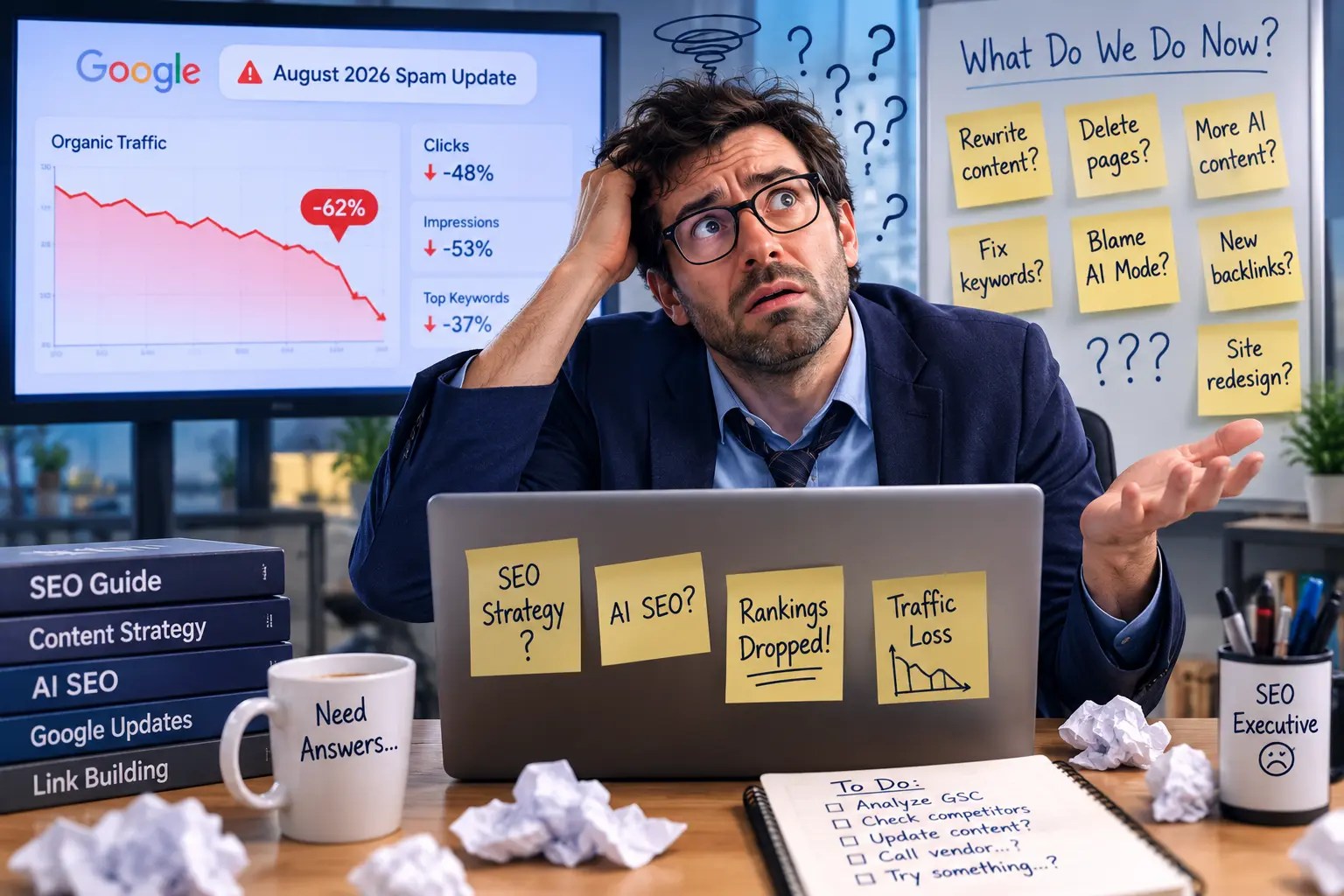
You can learn from my process.
Now, the first thing after a August 2026 Spam Update like this, I do is look at the analytics.
I want to know exactly when the decline started, how significant it is and what changed around that period. Then I go back through the previous two to three months and start looking for anything that could have contributed to the movement.
From there, I move into Google Search Console. I look at the search queries that lost impressions and clicks, the pages that lost traffic, the keywords that dropped in rankings and how all of that compares with the previous three months.
Then comes the part that usually gets missed: I go back to the actual pages.
I identify the blogs, landing pages and other pieces of content that look weak, outdated or simply don't add enough value. I don't immediately delete or rewrite everything. I build a list of pages that deserve a deeper review and have my team on standby to work through them systematically.
This is also where I see businesses panic.
The first reaction from many companies when they look at an update like August 2026 spam update, is to ask their marketing team to remove the articles, deindex pages or start rewriting everything immediately. I usually tell them to slow down. Let the rollout finish. Study what happened across the market. Look at competitors that gained visibility. Review what changed on your own site. Build the evidence first.
My usual window for reaching a much clearer conclusion is around two to three weeks after the rollout. By then, I have more data, my team has reviewed the client site and competitors, spoken with colleagues and started identifying patterns that are actually worth acting on.
I have seen this process uncover things that had very little to do with simply having “bad SEO.”
In one local business case, we found that competitors were doing a better job of demonstrating real experience. They had customer testimonials from the same industry inside their content, real numbers from projects, videos showing their work and much stronger local proof.
We changed our strategy around that insight.
We created real how-to videos showing the business in action, added short videos from the owner explaining why the company mattered to the local community, captured customer experiences, added real images from projects and created content around the products and materials the business actually used. We also took that content beyond the website. We published videos on YouTube, created short-form content for the Google Business Profile and continued building real-world visual proof of the business.
Within roughly three-four weeks, the local rankings improved. We also started seeing the business appear in AI-generated search results for relevant local queries. That experience reinforced something I have seen repeatedly throughout my career: genuine value creates multiple signals across search, local visibility and AI search experiences.
This is what I mean when I talk about creating value.
For a local roofing, flooring or landscaping business, value could mean showing customers how the work is actually done, explaining the products being used, answering the questions customers ask before hiring someone, sharing the owner's experience, documenting completed projects and giving potential customers real proof from people who have already used the service.
Those assets create something a generic article cannot: experience that can be seen, verified and understood.
The same principle applies to B2B and enterprise content. Real client results. Original research. Expert commentary. First-hand observations. Case studies. Data from actual projects. Testimonials. Demonstrations. Interviews. Videos. These are the assets that make content more useful and give your brand something credible to say.
AI can help with research, analysis, structuring, repurposing and speeding up production. I see a lot of value there. The problem starts when AI becomes the entire content strategy and the objective becomes publishing as much as possible. You cannot manufacture years of experience by generating 1,000 articles. You cannot manufacture client results. You cannot manufacture original data from projects you never worked on. You cannot manufacture genuine expertise by rephrasing what is already available online.
Google's current guidance is very clear that large-scale content created primarily to manipulate rankings can fall under scaled content abuse, regardless of the technology used to create it. Google has also explicitly included attempts to manipulate generative AI responses within its broader definition of spam.
So when rankings drop after an update, my advice is simple: don't panic and start deleting pages. Investigate first.
Look at your data. Look at the pages. Look at the competitors that gained visibility. Look at what they are doing better. Look at your technical, content and off-page signals. Then correlate everything with the timing of the update. After two or three weeks, you should have enough evidence to decide whether the strategy needs a correction, whether specific content needs improvement or whether competitors have simply built stronger signals around the same topic.
Then act.
That is how I approach Google updates: research first, understand what changed, identify what we missed and build a better strategy from the evidence.

With over 16 years at the forefront of strategic business growth, Sanjay Bhattacharya collaborates with CEOs and founders to reshape market positioning and drive sustainable success. Throughout his journey, he has worn many hats—from Fractional CMO for fast-growing startups to serving as Head of Marketing & Business Strategy at PRIMOTECH. He has been Featured in Under30CEO, American Marketing Association, CMO Times, CTOsync, DesignRush, Earned, HubSpot, MarketerInterview, and more.

.webp&w=32&q=75) 06 Oct 2026
06 Oct 2026