
.webp&w=48&q=75)
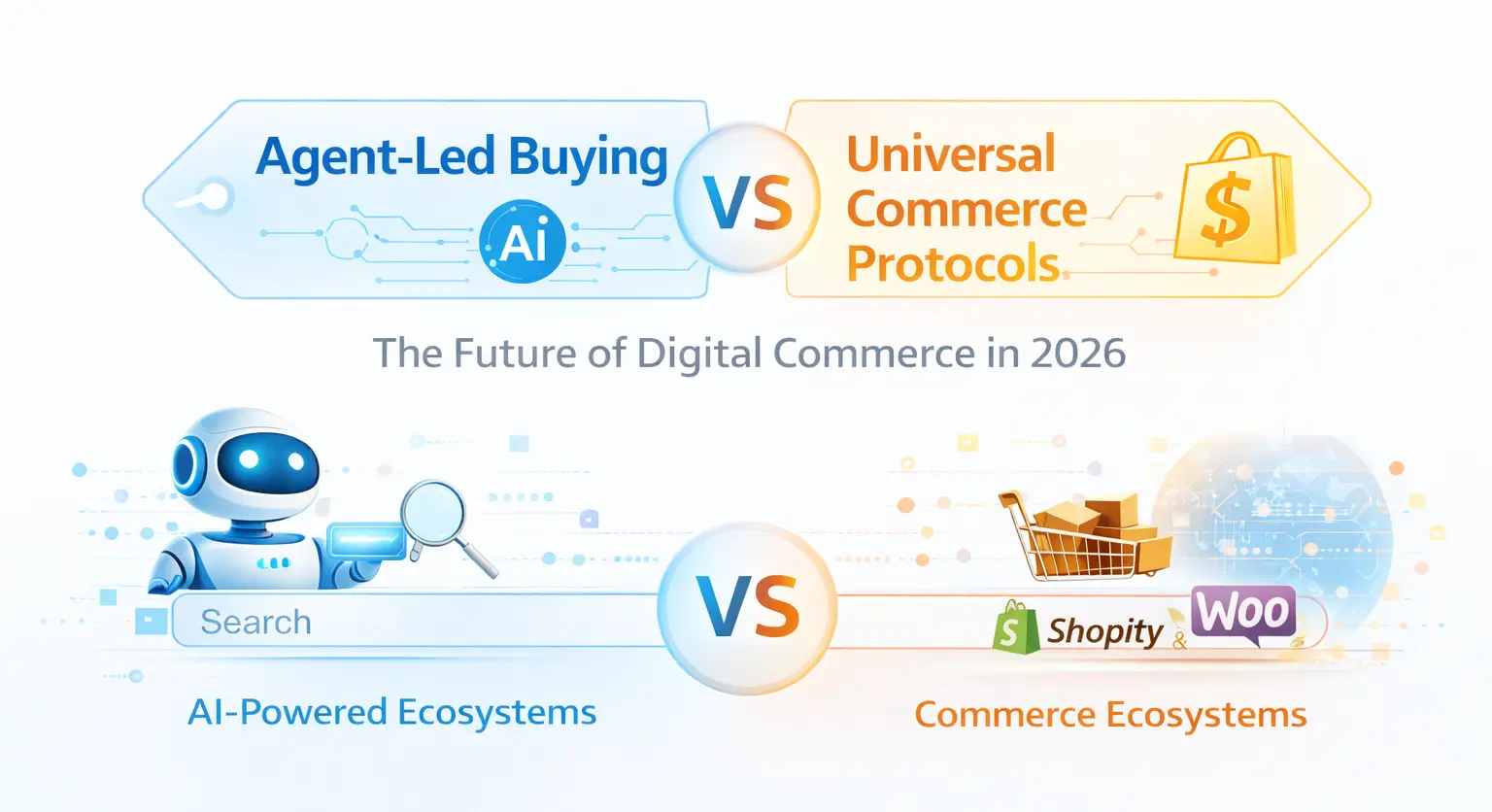
In 2026, digital commerce is beginning to split into two structurally different paths. One is driven by agent-led buying that evaluate options and make purchasing decisions on behalf of users. The other focuses on universal commerce protocols that standardize how transactions occur across platforms.
Recent platform documentation, infrastructure reports, and commerce-layer updates show these two models are evolving in parallel and they reshape discovery, trust, and marketing influence in very different ways.
Buying has traditionally been human-driven. First you search, then compare, then evaluate, and then you are ready to make a decision.
This flow is now being compressed. Major AI platforms are increasingly positioning agents as decision intermediaries, where users delegate intent rather than browse manually.
This is visible across AI assistants, automated recommendations, and task-based purchasing workflows. OpenAI has publicly described agent systems as tools that can plan, reason, and act across multi-step tasks, including decision support and execution. This is about decision delegation.
In an agent-led buying model, decision-making shifts from human browsing to machine evaluation. In this, it is the user that defines intent or constraints. The AI agent retrieves information across multiple sources, where options get evaluated programmatically and a shortlist, or a single recommended decision is produced.
This trend also explains why AI Overviews, even when they appear prominently, often don’t lead to results in isolation. As explored in our analysis of why AI overviews are not driving results, visibility alone without structured signals, depth, and agent-friendly content. It doesn’t translate into downstream decision influence. For practical steps marketers should take now, see why AI overviews aren’t converting and what you need to do next →
👉 https://sanjayb.com/why-ai-overviews-dont-drive-results/
This aligns with how modern agent-based and retrieval-augmented systems are designed to operate.
OpenAI defines agents as systems that can plan, reason, and take actions across tools and information sources to complete complex tasks, including evaluation and execution not just response generation.
Similarly, Google describes agentic systems as models that retrieve information, compare options, and act on behalf of users, reducing the need for manual exploration.
In this model, agents are not influenced by visual branding, emotional copy or page aesthetics. They evaluate reliability signals, structured and verifiable data. They also look into consistency across sources and historical performance indicators.
Marketing influence shifts from persuasion to eligibility, consistency, and trustworthiness.
Universal commerce protocols are often mentioned in the same breath as agent-led buying. Which is clearly not true as they are not competing models. They solve different layers of the system.
They focus on execution, not decision-making, and their goal is to make transactions interoperable across platforms, easier to complete, and less dependent on a single ecosystem making it consistent across regions and devices. It includes everything from payments, checkout flows, identity, to fulfillment and compliance. They remove friction after a decision has been made.
They do not decide what to buy. They only standardize how buying happens.
In an agent-led model, discovery looks very different.
The agent may scan search results, read documentation, compare reviews, evaluate pricing histories and cross-check multiple sources.
All of this happens before a human sees a page. By the time a recommendation is shown, the browsing phase is already over. This compresses the funnel and comparison traffic declines, exploration shrinks, and decision-making moves upstream.
This also explains why surface-level visibility, including AI Overviews, often fails to convert on its own. Visibility without decision influence does not survive agent evaluation.
Agents do not get impressed. They validate and look for signals that hold up across time and sources.
Questions agents implicitly ask and this is where marketers should focus their content to:
Is this brand consistently reliable?
Are claims supported elsewhere?
Is pricing stable or erratic?
Does historical performance match promises?
This pushes marketing closer to reputation systems, operational quality, data accuracy and long-term consistency
Short campaigns matter less than track records. Attention without trust is filtered out early.
I still see most teams are still optimizing for impressions, CTR, funnel progression and focused on conversion rate tweaks. While these are important in the traditional SEO format, agent-led buying does not reward these directly.
For that, they need to focus on clean, structured data that is crawlable. Build consistent content with clear entity relationships and ensuring low variance in messaging and performance.
Teams that are already struggling with crawl prioritization, content quality, or fragmented signals will struggle even more when agents become the evaluator. This ties directly back to how crawl visibility and index freshness now shape AI-driven discovery.
One important piece we haven’t talked about yet is where real commerce data actually comes from.
Agent-led buying does not happen in a vacuum. Agents still rely on structured, up-to-date product and service data.
This is where platforms like Google Merchant Center, Shopify, and WooCommerce quietly become critical infrastructure as signal providers.
Historically, Merchant Center feeds were treated as a paid shopping requirement which is an ads-only data source, something performance teams owned
Now that framing is outdated. It is an agent-driven ecosystem, merchant feeds act as structured truth layers, canonical product references and as consistency validators across systems.
Agents care deeply about:
product availability
pricing stability
attributes and variants
policy compliance
historical consistency
All of that lives in merchant feeds. So, If your feed is messy, inconsistent, or frequently out of sync, agents downgrade trust long before a user ever sees your brand.
Platforms like Shopify and WooCommerce are no longer just checkout engines.
They increasingly function as structured data generators, inventory truth layers and update frequency signals.
When agents evaluate products or services, they implicitly rely on:
how often data changes
whether pricing fluctuates unnaturally
whether attributes match across sources
whether availability is reliable
In traditional SEO, a messy product setup could still rank if backlinks were strong, content was good and the intent matched. However, in agent-led buying, that tolerance disappears.
Agents don’t “forgive” inconsistencies. They filter them out if your product feed contradicts your site, your availability is unreliable and if your attributes are incomplete.
This just doesnt cause loss in rankings but a loss in eligibility.
Most teams still treat Merchant Center, Shopify product hygiene and WooCommerce attribute cleanup as maintenance tasks. Whereas in reality, they are becoming decision-layer inputs.
Agent-led buying makes these systems part of the evaluation stack, not just the execution stack. That’s a fundamental shift.
Use this as a quick gut-check. If more than a few boxes are unchecked, you’re not agent-ready yet.
⬜ Product and service claims are consistent across website, feeds, and documentation
⬜ Pricing changes are controlled and explainable, not erratic
⬜ Reviews, testimonials, and third-party mentions align with on-site messaging
⬜ Brand entities are clearly defined and repeated across content
⬜ Google Merchant Center feeds are clean, accurate, and regularly updated
⬜ Product attributes are complete, not partially filled or auto-generated
⬜ Availability and inventory signals are reliable
⬜ Shopify or WooCommerce data matches on-site content exactly
⬜ High-value pages are crawled frequently and stay fresh in the index
⬜ Thin, duplicate, or outdated pages are pruned or consolidated
⬜ Internal linking clearly signals which pages matter most
⬜ Structured data is used where it adds clarity, not noise
⬜ Key pages answer questions clearly and early
⬜ Content is written for comprehension, not keyword manipulation
⬜ Pages are legible to both humans and machines
⬜ AI Overviews are treated as visibility signals, not primary KPIs
⬜ Success is not measured only by CTR or rankings
⬜ Visibility is evaluated across search, AI tools, and commerce surfaces
⬜ Teams understand the difference between visibility and decision influence
⬜ Leadership expectations are aligned with how AI-driven buying actually works
Agent-led buying doesn’t replace commerce platforms.
It raises the bar for how clean and trustworthy those platforms must be.
Universal commerce protocols make transactions easier.
Agent-led systems decide whether you get considered at all.
And the data that feeds those decisions often comes from places teams have historically ignored.

With over 16 years at the forefront of strategic business growth, Sanjay Bhattacharya collaborates with CEOs and founders to reshape market positioning and drive sustainable success. Throughout his journey, he has worn many hats—from Fractional CMO for fast-growing startups to serving as Head of Marketing & Business Strategy at PRIMOTECH. He has been Featured in Under30CEO, American Marketing Association, CMO Times, CTOsync, DesignRush, Earned, HubSpot, MarketerInterview, and more.
.webp&w=32&q=75) 06 Oct 2026
06 Oct 2026