
.webp&w=48&q=75)

AI SEO in 2026 is no longer about using smarter tools. It is about building search visibility systems that work across Google Search, AI Overviews, and large language models.
Artificial intelligence has changed how search engines understand content, intent, and authority. Rankings today are influenced by far more than keywords and backlinks. Entities, topical depth, user behavior, and answer quality now play a central role in how visibility is earned and sustained.
This shift has created confusion. Many businesses assume that adopting AI SEO tools automatically improves performance.
In reality, tools only amplify whatever strategy already exists. Without clarity, AI accelerates activity but rarely delivers meaningful outcomes.
At SanjayBConsulting, we treat AI SEO as a strategic capability, not a software decision. AI supports content systems, keyword intelligence, SERP analysis, and workflow efficiency.
Strategy determines whether those capabilities translate into consistent rankings, qualified traffic, and long-term visibility across search and AI platforms.
This guide explains what AI SEO really means in 2026, how it differs from earlier AI-driven SEO approaches, and how businesses should think about AI SEO tools from a strategic, not tactical, perspective.
Artificial Intelligence in digital marketing is no longer about automation or experimentation.
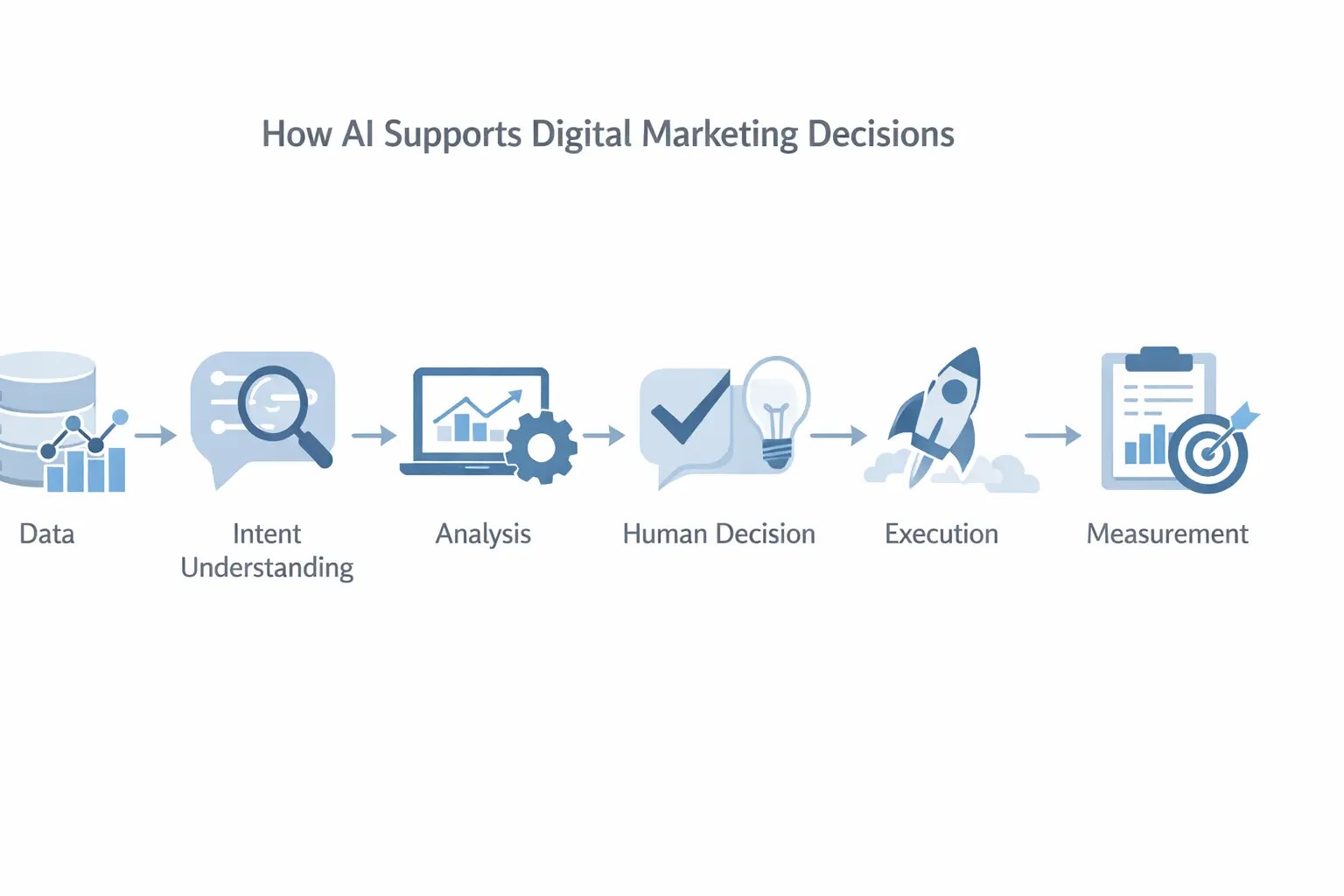
In 2026, AI is used to interpret intent, predict behavior, and support decision-making across content, SEO, paid media, and analytics.
At its core, AI helps marketers answer three questions faster and more accurately:
What does the audience actually want right now?
How do search engines and platforms interpret that intent?
Which actions are most likely to drive measurable outcomes?
Instead of replacing marketers, AI augments human judgment by processing large volumes of data, detecting patterns, and surfacing insights that would otherwise be missed.
AI in digital marketing is built on a few foundational capabilities. The difference in 2026 is how they are applied.
NLP allows systems to understand meaning, context, and intent behind language, not just keywords.
In SEO and content strategy, NLP is used to:
Interpret search intent beyond exact-match queries
Evaluate topical depth and semantic coverage
Align content with how modern search engines process language
This is why keyword stuffing stopped working years ago and why content relevance today is evaluated holistically.
Machine learning systems learn from data patterns and improve predictions over time.
In marketing use cases, this includes:
Predicting which topics are likely to gain traction
Identifying ranking volatility and trend shifts
Improving content prioritization and internal linking decisions
Machine learning does not “decide” strategy. It supports faster iteration and better prioritization.
Deep learning models analyze complex relationships across large datasets.
In practical terms, this enables:
Understanding multi-touch buyer journeys
Interpreting user behavior across platforms
Supporting advanced personalization and content recommendations
This is especially relevant for businesses operating across multiple channels, markets, or content formats.
SEO has always been data-heavy.
What’s changed is volume, speed, and complexity.
In 2026, SEO teams are dealing with:
Rapid SERP volatility
Semantic search and entity-based indexing
AI Overviews and generative search layers
Multi-intent queries that no longer map to single keywords
Manual SEO workflows break under this pressure. AI is not introduced to “hack rankings”, but to process patterns humans can’t consistently track at scale.

AI strengthens SEO in four specific areas. Outside of these, it adds little value.
AI models analyze large sets of queries, SERP layouts, and content patterns to infer why users are searching, and not just what they type.
This helps move SEO away from keyword matching and toward intent coverage.
AI assists in identifying content gaps, comparing topical coverage across competitors and highlighting structural weaknesses (not “writing for you”)
Modern SERPs change fast.
AI helps detect ranking volatility, feature shifts (AI Overviews, video blocks, PAA) and content formats winning visibility.
This allows teams to respond before any rankings drop.
AI improves task prioritization, content briefs, update recommendations and internal linking opportunities
This is where AI delivers real ROI that is time saved without any shortcuts.
In 2026, successful SEO teams stop asking:
“Which AI SEO tool should we use?”
And start asking:
“Which SEO decisions should be augmented by AI, and which must remain human-led?”
This shift is the difference between:
Scaling visibility sustainably
Or producing high-volume content that never compounds
AI-powered digital marketing is no longer optional for scale, but strategy still determines success.
Businesses that win are not the ones using the most tools.
They are the ones using AI to:
Make better decisions
Reduce wasted effort
Focus on high-impact actions
Maintain consistency across content and search ecosystems
This is where AI SEO becomes a strategic capability, not a software choice.

In 2026, AI SEO tools fall into a few clear functional categories. Understanding these categories matters more than the tools themselves.
These tools help teams understand:
What topics competitors are covering
Where content gaps exist
How well a site covers an entity or theme
They are useful for topic cluster planning, content audits and updates, and identifying weak or thin sections.
They are not meant to replace subject matter expertise and generate final content without review.
The real value comes from evaluation and prioritization. Used correctly, these tools reduce guesswork and help content compound over time.
Traditional keyword tools focused on search volume. Modern AI SEO tools focus on intent relationships and semantic structure.
These tools help with mapping primary and supporting intents, understanding entity relationships, and building keyword clusters that reflect real search behavior.
They are especially useful for large sites with multi-intent topics, and content consolidation strategies.
However, they do not define strategy. They surface patterns and humans are the ones who decide the direction.
Search results today are not static. AI-powered SERP tools help detect ranking volatility across clusters, help feature dominance such as AI Overviews, video blocks, or PAA, and identify format shifts influencing visibility.
This allows teams to react before traffic drops, adjust content format, not just keywords and understand why rankings change, not just that they changed.
This category is critical for defensive SEO and risk management.
Some AI SEO tools focus on execution efficiency. These tools assist with content briefs and outlines, internal linking suggestions, update and refresh recommendations and SEO task prioritization.
Their value lies in reducing repetitive analysis, improving consistency and supporting teams at scale.
They do not replace quality control or editorial judgment. This is where AI delivers time leverage, not creative advantage.
AI-generated content tools are widely misunderstood. They can support you to draft internal notes or outlines, rewrite for clarity, and even help scale low-risk pages with oversight.
However, they should not be used to replace expert-led content, publish at scale without review and mimic authority without substance.
Search engines and LLMs increasingly reward original insight, structure, and perspective. AI-generated content without human guidance often plateaus or declines.
Instead of asking:
“Which AI SEO tool is best?”
Businesses should ask:
Which SEO decisions require pattern recognition?
Which decisions require human judgment?
Where does speed improve outcomes?
Where does automation introduce risk?
The best AI SEO stacks are capability-driven, modular and can be easily integrated into strategy.
Tools should serve the system, and the system should serve the business goals.
An effective AI SEO strategy is not built by stacking tools. It is built by designing a system where AI supports the right decisions at the right stage.
Most SEO programs stall because they apply AI tactically instead of structurally.
Take note that SEO metrics are signals, and business outcomes are the goal.
So, before introducing AI into SEO workflows, teams must define:
Which business outcomes SEO is expected to influence
Which stages of the buyer journey matter most
How success will be measured beyond rankings and traffic
AI performs best when it supports clear objectives. Without this clarity, automation accelerates the wrong work.
AI should be applied only where it improves decision quality or speed.
High-impact use cases include:
Prioritizing content updates based on opportunity, not intuition
Identifying intent mismatches across ranking pages
Detecting structural gaps in topical coverage
Monitoring SERP behavior at scale
Low-impact or risky use cases include:
Fully automated content publishing
Strategy definition without human oversight
Brand positioning decisions driven by models alone
This distinction prevents over-reliance on tools and protects long-term authority.
The strongest AI SEO strategies follow a simple rule:
AI supports analysis and execution. Humans own judgment and direction.
A practical workflow looks like this:
Humans define goals, positioning, and editorial standards
AI assists with research, pattern detection, and prioritization
Humans review, refine, and approve outputs
AI supports monitoring and iteration
This balance creates scale without sacrificing quality.
AI makes it easy to produce more content.
It does not guarantee better results.
Compounding SEO actions include:
Updating and consolidating existing content
Strengthening internal linking across related topics
Improving clarity and structure for intent alignment
Building topical authority over time
AI should be used to identify where compounding is possible, not to increase publishing velocity alone.
Instead of asking whether AI tools are being used, teams should ask:
Did decision-making improve?
Did prioritization become clearer?
Did execution speed increase without quality loss?
Did content performance stabilize or compound?
If AI is not improving these areas, it is likely misapplied.
Technology should reduce friction, not introduce complexity.
As AI tools become more accessible, the differentiator is no longer software.
It is judgment, systems thinking, and execution discipline.
This is where experienced strategy-led SEO teams provide value:
Designing AI-aware SEO systems
Avoiding automation traps
Aligning SEO with business outcomes
Ensuring AI supports authority, not undermines it
AI has permanently changed how SEO is executed. It has not changed what ultimately drives visibility.
Search engines and AI-driven discovery systems still reward:
Clear intent alignment
Topical depth
Structural clarity
Trust and authority built over time
What AI changes is how efficiently those outcomes can be achieved.
Businesses that treat AI SEO as a shortcut often plateau. Those that treat it as a strategic capability compound results.
The difference is not access to tools. It is how decisions are made, prioritized, and executed.
In 2026 and beyond, successful SEO will belong to teams that combine:
Human judgment
Systems thinking
AI-supported analysis and execution
That balance is what turns SEO from a traffic channel into a durable growth engine.
If your SEO efforts feel busy but disconnected from outcomes, if content volume has increased without clear gains, or if AI tools are being adopted without a unifying strategy,
it is usually a signal that execution has outpaced direction. That is where a strategy-first AI SEO approach creates leverage.
At SanjayBConsulting, we help businesses design and execute AI-aware SEO systems that are built for long-term visibility, not short-term spikes.
Our work focuses on:
AI SEO strategy and system design
Content and topical authority building
Search visibility across Google and AI platforms
Decision frameworks that scale without compromising quality
If you want AI to support growth instead of adding complexity, a strategy conversation is often the right place to start.
Get in touch at: contact@sanjayb.com
AI SEO in 2026 refers to using artificial intelligence to support search strategy, content intelligence, SERP analysis, and workflow efficiency. It focuses on improving decision-making and scalability, not replacing SEO fundamentals or human judgment.
AI SEO tools are not mandatory, but they are increasingly helpful for scale. Businesses with large sites, frequent updates, or competitive SERPs benefit most when AI supports prioritization and analysis.
No. AI SEO tools do not improve rankings on their own. They amplify existing strategy. Without clear goals, editorial standards, and intent alignment, AI tools often increase activity without improving outcomes.
Traditional SEO relied heavily on manual keyword research and static optimization. AI SEO adds pattern recognition, intent modeling, and SERP behavior analysis, allowing teams to adapt faster and make better-informed decisions.
AI-generated content can rank when it is reviewed, refined, and guided by human expertise. Content published at scale without original insight or quality control often fails to sustain performance over time.
AI SEO helps structure content so it can be understood and surfaced by systems like Google AI Overviews and large language models. This includes clear explanations, entity alignment, and answer-focused content structure.
Common mistakes include relying on automation without strategy, publishing AI-generated content at scale, chasing tools instead of outcomes, and ignoring intent alignment and authority building.
AI SEO delivers the most value for larger or growing websites where manual analysis becomes inefficient. However, even smaller teams can benefit when AI is applied selectively and strategically.
Businesses should evaluate AI SEO tools based on the decisions they support, not the number of features. The key question is whether a tool improves prioritization, clarity, and execution without increasing complexity.
No. AI SEO increases the importance of expertise. Human judgment is required for strategy, positioning, content quality, and interpretation of insights generated by AI systems.
Results depend on baseline authority, competition, and execution quality. AI can improve speed and efficiency, but sustainable SEO gains still compound over time rather than appearing instantly.
A business should consider an AI SEO consultant when SEO efforts feel fragmented, AI tools are being adopted without clarity, or visibility growth has stalled despite increased activity.

With over 16 years at the forefront of strategic business growth, Sanjay Bhattacharya collaborates with CEOs and founders to reshape market positioning and drive sustainable success. Throughout his journey, he has worn many hats—from Fractional CMO for fast-growing startups to serving as Head of Marketing & Business Strategy at PRIMOTECH. He has been Featured in Under30CEO, American Marketing Association, CMO Times, CTOsync, DesignRush, Earned, HubSpot, MarketerInterview, and more.

.webp&w=32&q=75) 19 Aug 2026
19 Aug 2026