
.webp&w=48&q=75)
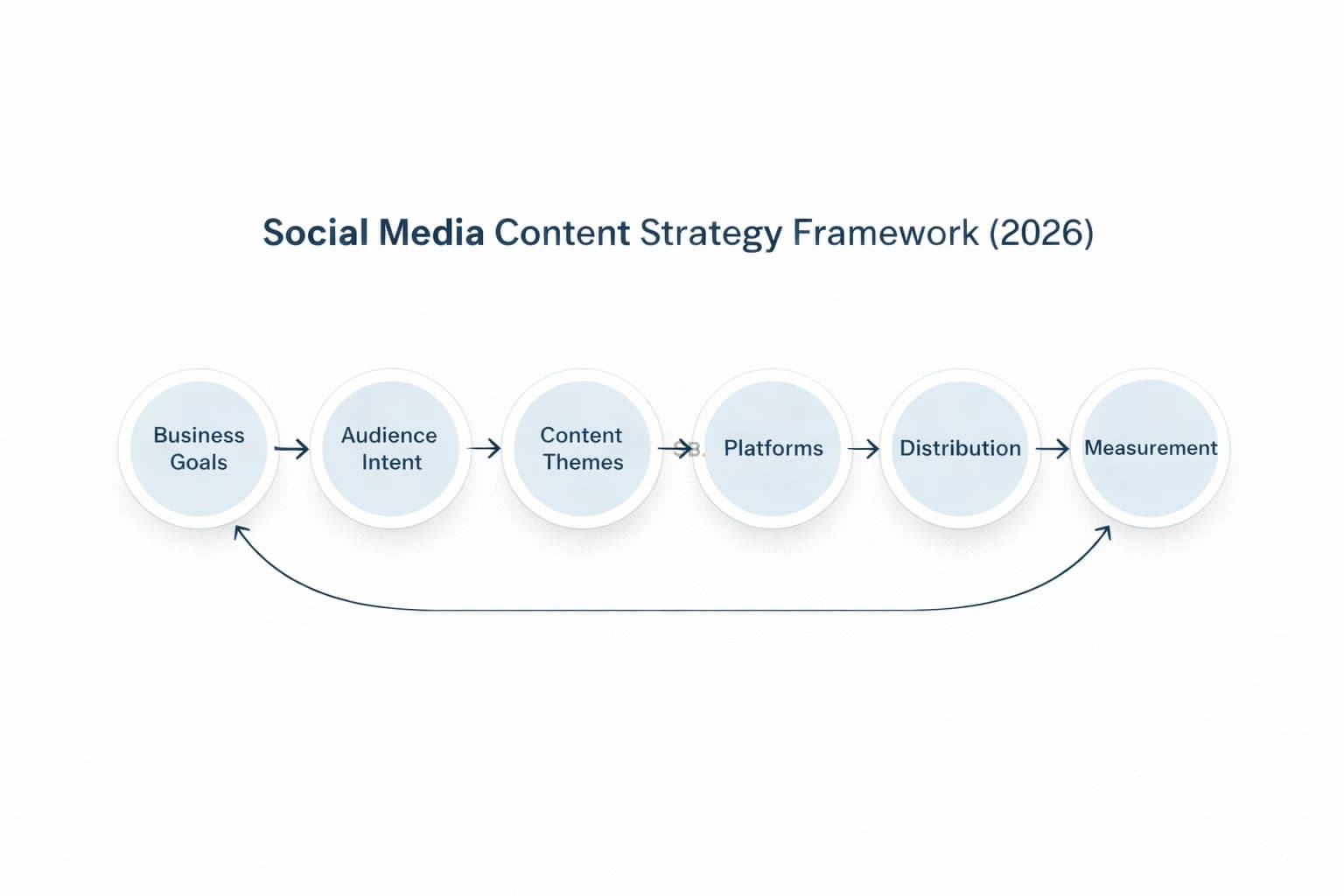
An effective social media content strategy in 2026 is not about posting consistently. It is about designing a system that connects content, distribution, data, and business outcomes.
For most businesses, this means aligning social content with clear goals, defined audiences, and measurable outcomes.
Social media today functions as a demand creation and trust-building layer across the buyer journey. It influences discovery, validation, and conversion. Yet most brands still treat it as a publishing task instead of a strategic growth input.
At SanjayBConsulting, this is one of the most common gaps we see. Teams produce content regularly, invest in tools, and follow platform trends, but struggle to tie social activity to pipeline, revenue, or long-term brand equity.
This guide breaks down how to create a modern social media content strategy that works in 2026 and beyond. One that aligns with SEO, paid media, content marketing, CRO, and AI-assisted workflows. The focus is not hacks or templates. The focus is clarity, structure, and measurable impact.
If this problem feels familiar and you are serious about tying social efforts to growth, a strategy conversation is usually the right starting point.
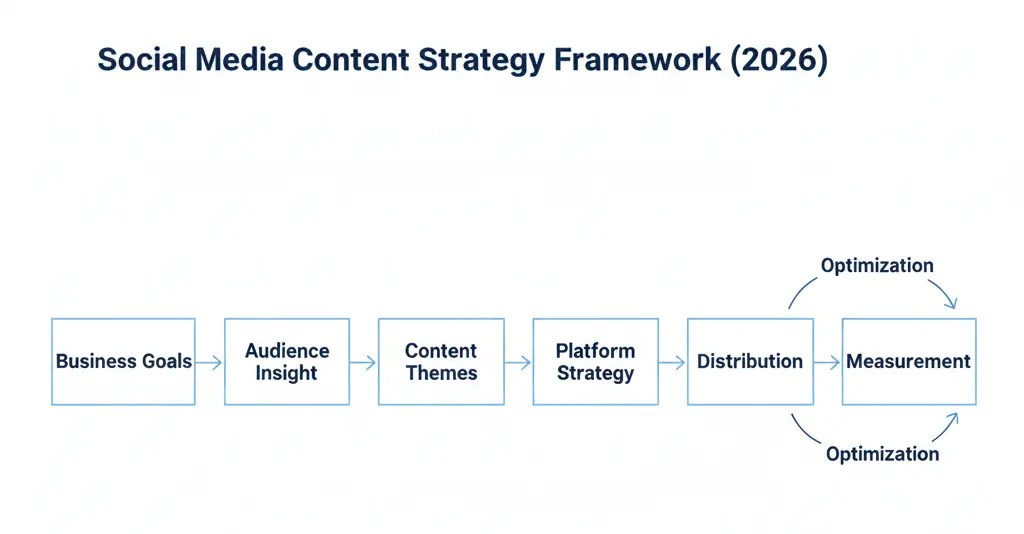
A modern social media content strategy is not a checklist. It is a connected framework that aligns business goals, audience insight, content systems, and distribution.
For most businesses, this means designing social media as part of a larger growth system, not a standalone channel.
Before diving into execution, every strategy should be grounded in a few clear answers. Not tactical answers but strategic ones.
Ask yourself:
Who is this content meant to influence and at what stage of the buyer journey?
What business problem should social media help solve?
What authority or differentiation does the brand bring to the conversation?
Which formats and platforms support that objective best?
How will performance be evaluated beyond surface-level engagement?
At SanjayBConsulting, this framework is how we prevent teams from publishing content that looks busy but delivers little measurable business impact.
The steps below follow this logic intentionally.

In 2026, social media goals must be defined as business outcomes, not content activities.
Posting regularly, increasing followers, or improving engagement are not goals. They are signals.
The real question is how social media supports growth across awareness, demand, pipeline influence, or retention.
This is usually where strategy breaks down. Teams jump into content calendars before deciding what success actually looks like.
A strong social media strategy starts by clearly defining:
What business outcome social media should influence
Which stage of the buyer journey it supports
How success will be measured beyond likes, views, or impressions
Without this clarity, content decisions become reactive and reporting becomes meaningless.
Different businesses need different outcomes from social media.
Early-stage brands
Focus on awareness, education, and trust signals.
Growth-stage teams
Use social media to influence demand, support lead generation, and assist conversions.
Established businesses
Prioritize brand authority, retention, and multi-touch revenue influence.
An effective social media content strategy is built around influence, not demographics.
In the upcoming years, understanding your audience will go far beyond age, location, or interests.
What matters most is intent.
At SanjayBConsulting, we rarely start with personas in the traditional sense. We start by identifying:
Who needs to be influenced
What decision they are trying to make
What would move them one step closer to trust or action
This shift alone changes how content is planned, written, and distributed.
It will help you build clear buyer personas. Furthermore, it will help you produce more relevant and valuable content with the right message for targeting the right consumers in social media ads.
Traditional personas describe who someone is.
Effective social strategies focus on why they care right now.
Ask these questions instead:
What problem is this audience actively trying to solve?
What triggers them to look for information or validation?
What objections or risks are holding them back?
What would make them trust your perspective?
When content is built around intent, relevance improves automatically. Engagement becomes a by-product, not the goal.
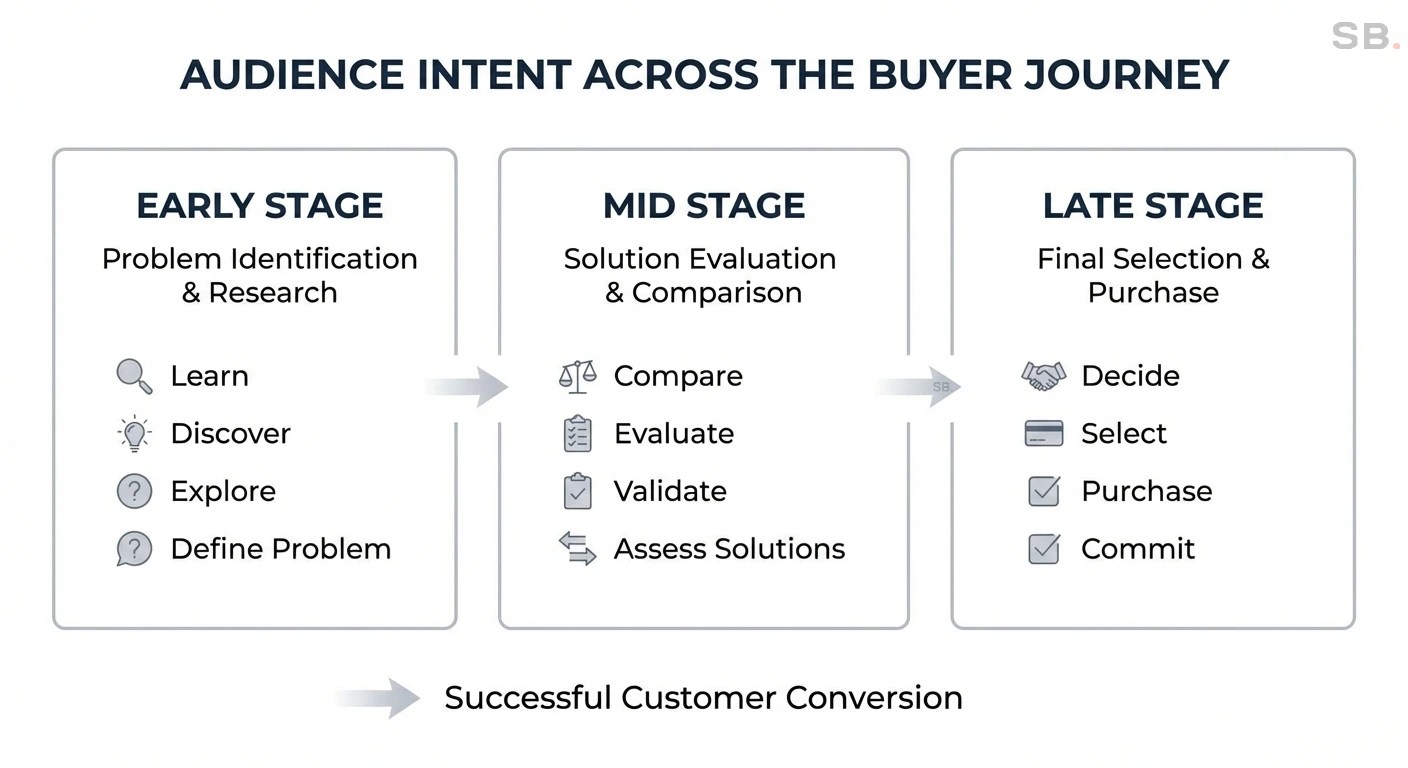
Not all content is meant to convert immediately. Different stages require different types of influence:
Early stage
Education, awareness, problem framing, point of view.
Mid stage
Validation, comparisons, credibility, proof.
Late stage
Risk reduction, clarity, differentiation, decision confidence.
Most brands fail because they create the same type of content for every stage.
In 2026, competitive analysis is less about copying content and more about identifying gaps in positioning, messaging, and authority.
Instead of asking what competitors are posting, the more useful questions are:
What conversations dominate the category?
What viewpoints are missing or underexplored?
Where do competitors sound identical?
What objections are they failing to address?
At SanjayBConsulting, we treat competitive analysis as signal analysis. The goal is not to replicate content formats, but to identify opportunities to differentiate and lead.
Social listening, content audits, and SERP analysis should be used to understand:
Narrative gaps
Overused talking points
Weak authority signals
That is where content strategy creates leverage.
A social media audit in 2026 is not just a content review. It is a baseline for decision-making.
Before changing strategy, you need clarity on:
What content consistently earns attention
What fails to influence action
Which platforms contribute to traffic, leads, or brand trust
Where effort is being wasted
This step should focus on:
Performance patterns, not isolated posts
Message resonance, not just engagement
Platform contribution, not follower count
Without a baseline, optimization becomes guesswork.
This is usually where teams uncover why effort has not translated into results.
 Get a free social media audit report!
Platform selection should be driven by audience intent and business impact, not usage statistics.
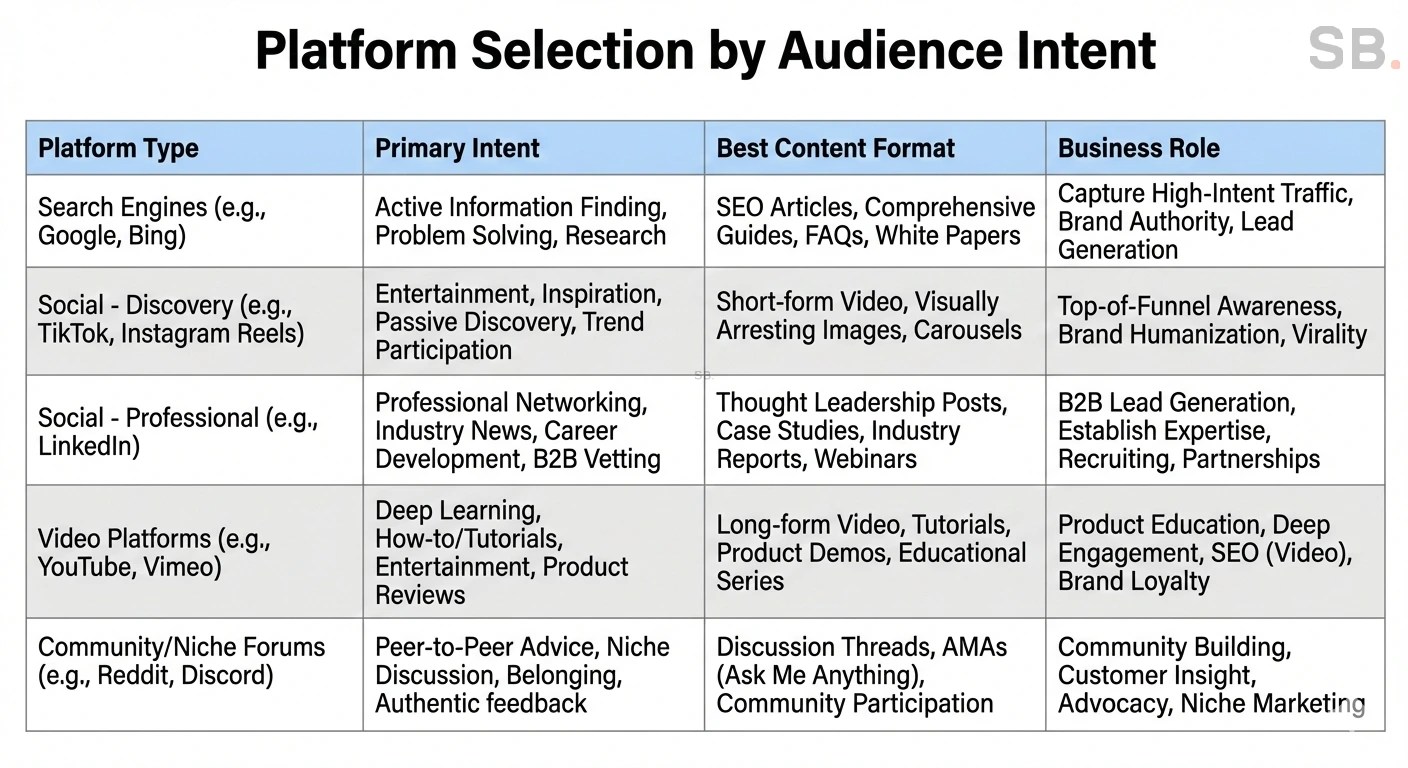
The most effective strategies focus on fewer platforms where influence can be sustained, rather than chasing visibility everywhere. The right platform is the one where:
Your audience is making decisions
Trust can be built consistently
Content format aligns with your message
Distribution can be sustained
For many businesses, fewer platforms with better alignment outperform broad but shallow presence.
At SanjayBConsulting, platform decisions are made after goals, audience intent, and baseline performance are clear. Not before.
Effective social media strategies are built around themes, not formats.
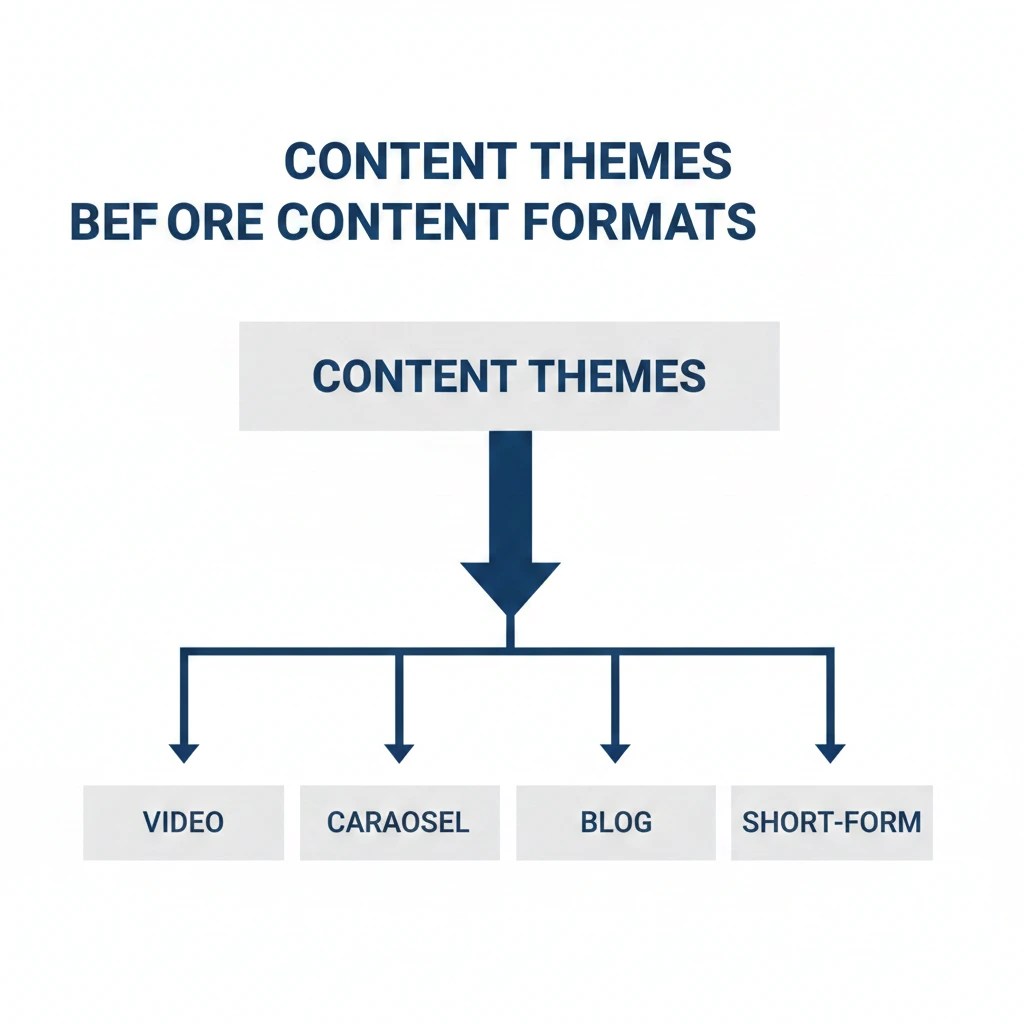
In 2026, deciding what to post is less important than deciding what you want to be known for. Content formats change. Platforms evolve. Strategic themes compound.
At SanjayBConsulting, we structure social content around a small set of repeatable themes that align with business goals, audience intent, and brand authority.
Examples of strong content themes include:
Problem framing and industry insight
Opinionated points of view
Educational breakdowns
Proof through experience, results, or case context
Trust-building narratives
Formats like videos, carousels, blogs, or podcasts are execution layers. The theme is the strategy.
Consistency comes from systems, not calendars.
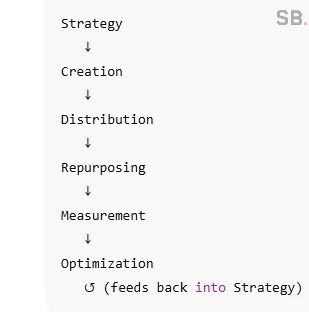
A sustainable content strategy works as a loop, not a linear checklist.This approach allows teams to scale output, improve quality, and extend content lifespan without increasing workload.
A content calendar is a coordination tool, not a strategy. In 2026, high-performing teams think in terms of content systems that balance creation, distribution, and reuse.
A sustainable system accounts for:
Production capacity
Content reuse across platforms
Distribution priorities by intent
Integration with SEO, paid media, and email
At SanjayBConsulting, we design content systems that prevent burnout and maximize reach without increasing workload.
Distribution is not an afterthought. It is part of the design. Content should be created with its distribution path already defined.
In 2026, measurement should answer one question. Is social media influencing business outcomes?
Engagement metrics alone do not tell that story. What matters is how content contributes to:
Qualified traffic
Lead quality
Conversion support
Brand authority over time
Measurement should focus on:
Patterns, not individual posts
Assisted conversions, not last clicks
Signal strength, not vanity metrics
Without this perspective, optimization becomes reactive and misleading.
An effective social media content strategy in 2026 is not built on trends, tools, or posting frequency. It is built on clarity. Clear goals. Clear audience intent. Clear positioning. And a system that connects content to business outcomes.
Social media now plays a critical role across discovery, validation, and decision-making. Treating it as a standalone channel limits its impact. Designing it as part of a broader growth system allows it to compound over time.
At SanjayBConsulting, we help brands move away from reactive content execution and toward strategy-first social media systems that support growth, authority, and measurable results. This approach works because it aligns content, distribution, and measurement with real business priorities.
If you want to design a social media content strategy that supports growth instead of chasing metrics, a strategy conversation is usually the right starting point.
Need a quick content consult? Get in touch with me at contact@sanjayb.com.
A social media content strategy in 2026 is a system that aligns business goals, audience intent, content themes, distribution, and measurement. It focuses on influence and outcomes, not just publishing activity.
Social media supports growth by influencing buyer decisions across awareness, consideration, and conversion stages. Its impact is often indirect, contributing to trust, validation, and assisted conversions rather than last-click sales.
Platforms should be selected based on audience intent and business role, not popularity. The best platforms are those where decision-making happens and where content can consistently build trust and authority.
Content calendars help organize work, but systems enable scale. A content system connects strategy, creation, distribution, repurposing, and measurement so output improves without increasing effort.
Consulting-led teams start with business outcomes and decision context before planning content. This ensures social media supports growth strategy instead of operating as an isolated marketing activity.
AI changes social media strategy by improving content ideation, distribution timing, performance analysis, and repurposing. However, AI works best when guided by clear strategy, audience intent, and business goals. Without that foundation, AI only accelerates noise.
Social media rarely works as a direct conversion channel on its own. Its real value lies in influencing decisions, supporting demand generation, and strengthening trust across the buyer journey. When integrated with SEO, paid media, CRO, and sales workflows, it can significantly impact revenue.
The most common mistakes include chasing trends, posting without clear goals, measuring vanity metrics, and treating social media as a standalone channel. These issues usually stem from a lack of strategy rather than lack of effort.
A business should consider a strategy consultant when social media activity feels busy but ineffective, when growth stalls despite consistent posting, or when content efforts are disconnected from pipeline and revenue outcomes.

With over 16 years at the forefront of strategic business growth, Sanjay Bhattacharya collaborates with CEOs and founders to reshape market positioning and drive sustainable success. Throughout his journey, he has worn many hats—from Fractional CMO for fast-growing startups to serving as Head of Marketing & Business Strategy at PRIMOTECH. He has been Featured in Under30CEO, American Marketing Association, CMO Times, CTOsync, DesignRush, Earned, HubSpot, MarketerInterview, and more.
.webp&w=32&q=75) 06 Oct 2026
06 Oct 2026